Market Hours: When Spot Markets Open and Close
Spot Trading Beginner About 4 min Audio free Video · Premium
Stocks keep office hours, crypto never sleeps — and the clock changes how prices behave.
Watch your teacher
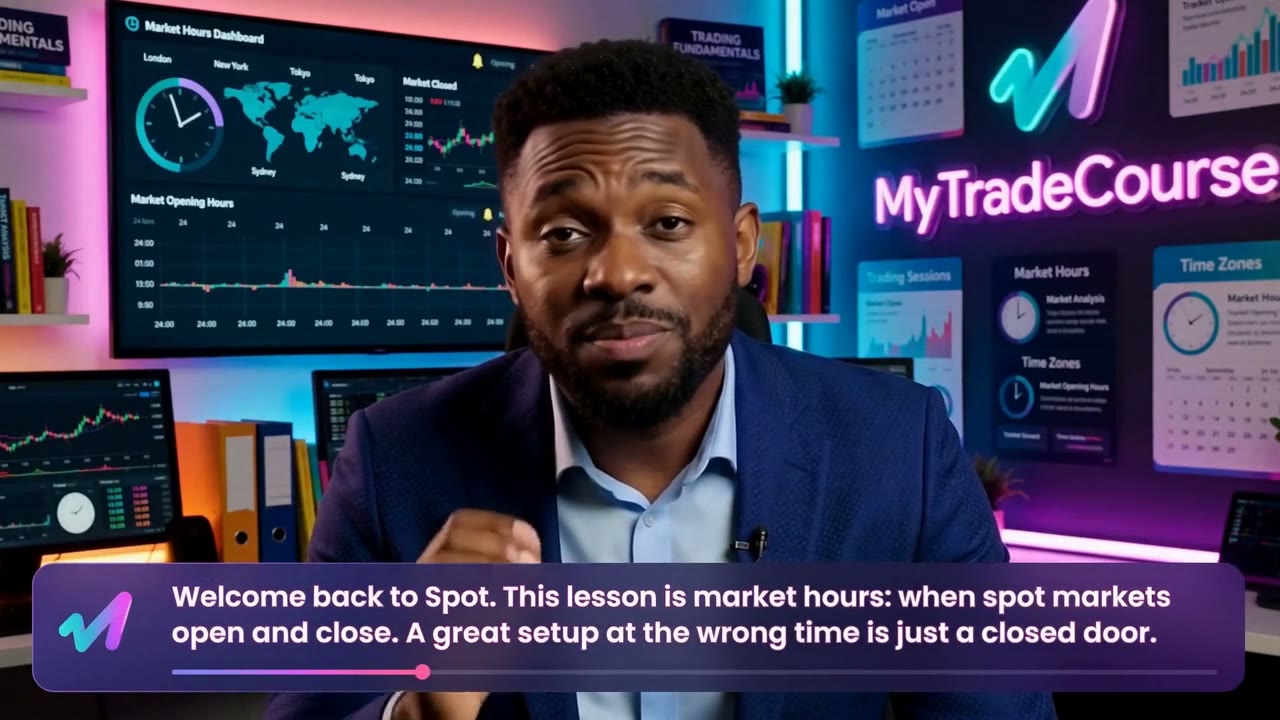
This video is part of Premium
Premium is not open yet. No Premium price is shown and nothing is charged until the owner opens it. The full lesson is below, and the audio is free right now.
Listen — free
The teacher's voice for this lesson (1:00). This lesson's audio is free.
Read the transcript
Welcome back to Spot. This lesson is market hours: when spot markets open and close. A great setup at the wrong time is just a closed door. Not every spot market keeps the same hours. Stock markets open and close at set times on weekdays, set by the exchange they trade on. When a stock market is closed, you cannot buy or sell there. Orders you place wait until the market opens again, and the price may have moved by then. Some spot markets run much longer. Currency markets trade almost around the clock on weekdays, passing from one city to the next, and crypto trades all day, every day. Before you trade, check three things: which market it is, what hours it keeps in your own time zone, and whether a holiday closes it early. Remember: know the hours before you plan the trade. Open, closed, or holiday — check first. Now — try the quick quiz.
Different markets, different clocks
US stock markets trade a core session (9:30–16:00 Eastern) with thinner pre- and post-market hours around it. Crypto trades 24/7. Currency spot effectively runs around the clock on weekdays. The clock matters because liquidity follows people: the busiest hours have the tightest spreads and most reliable fills; the quiet hours have gaps, jumps, and expensive surprises.
The open and the close are special
The first and last 30 minutes of a stock session concentrate a huge share of the day's volume as funds position and rebalance. Prices move faster and whipsaw more. Many beginners do better avoiding the opening minutes entirely — let the first wave of orders clear, then trade the calmer mid-session with the day's range partly revealed.
Overnight risk in 'hold forever' assets
A spot stock position held overnight can gap — open far from yesterday's close on news — and no stop-loss can fill at a price that was never traded. That gap risk is part of spot equity trading, and it is one reason position size, not the stop alone, is your real protection.
Worked example — the same stock, two clocks
At 11:00 a heavily traded stock shows a 1-cent spread and fills instantly at the quote. At 19:00 in post-market, the same stock shows a 25-cent spread on a handful of shares. A market order for 200 shares in the evening fills in pieces, some 40 cents above the last print. Same asset, same day — the hour chose the cost.
Remember this
- Liquidity follows the clock: busy hours = tight spreads, quiet hours = gaps.
- Opens and closes are fast and whipsaw-prone; beginners often sit them out.
- Overnight gaps can jump clean over a stop — size is the real protection.
Check what you learned
Completion marks are saved on this device only.
SEO used on this page
| Page title | Set — Market Hours: When Spot Markets Open and Close — Spot Trading | MyTradeCourse |
|---|---|
| Meta description | Set — Stocks keep office hours, crypto never sleeps — and the clock changes how prices behave. |
| Share picture | Set — https://mytradecourse.com/media/thumbs/mytradecourse-spot-market-hours-lesson-thumbnail.jpg |
| Audio file | Set — /media/audio/mytradecourse-spot-market-hours-lesson-audio.mp3 |
| Video file | Set — mytradecourse-spot-market-hours-lesson.mp4 (Premium) |
| Captions | Set — /media/captions/mytradecourse-spot-market-hours-lesson-captions.vtt |
| Transcript | Set — shown on this page under Listen |
| Structured data | Set — LearningResource + VideoObject |