Choosing Where to Trade: Brokers and Exchanges
Spot Trading Beginner About 5 min Audio free Video · Premium
Fees, safety, and what happens if the company fails — the unglamorous choice that protects everything else.
Watch your teacher
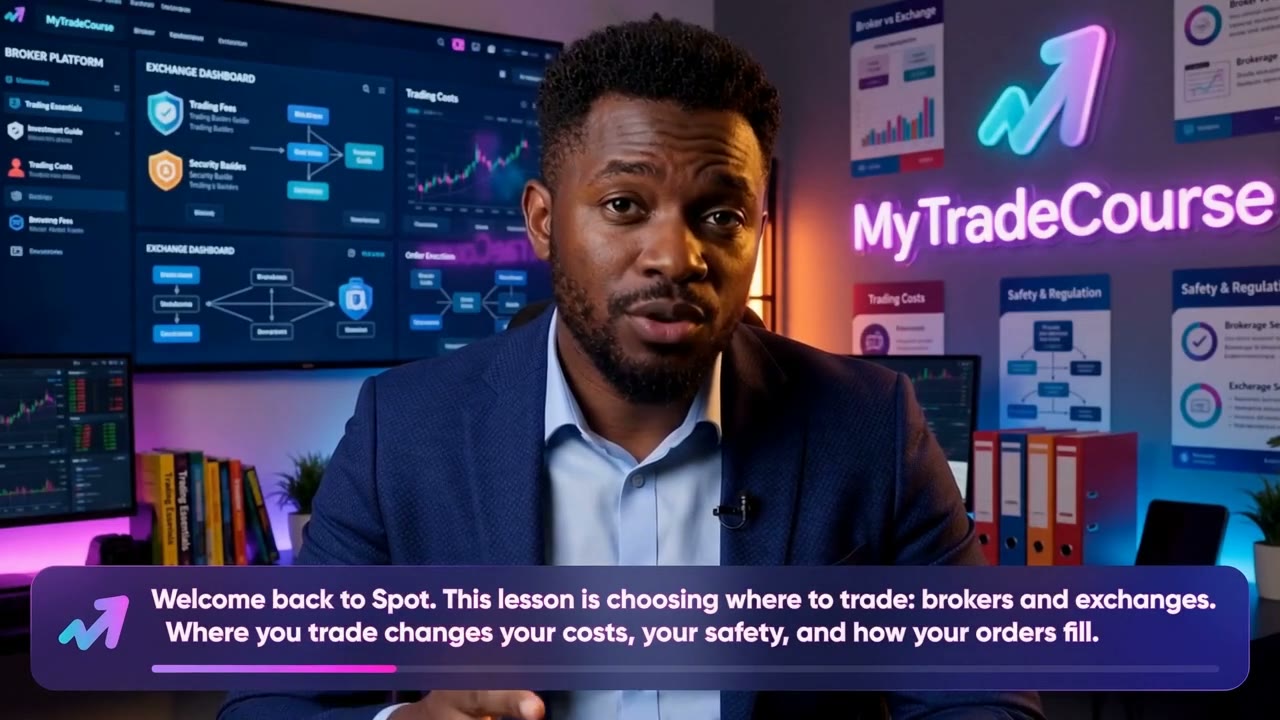
This video is part of Premium
Premium is not open yet. No Premium price is shown and nothing is charged until the owner opens it. The full lesson is below, and the audio is free right now.
Listen — free
The teacher's voice for this lesson (1:00). This lesson's audio is free.
Read the transcript
Welcome back to Spot. This lesson is choosing where to trade: brokers and exchanges. Where you trade changes your costs, your safety, and how your orders fill. An exchange is a marketplace where buyers and sellers meet directly. You place your order, and the exchange matches it with someone on the other side. A broker sits in the middle. The broker takes your order and routes it, sometimes to an exchange, and helps with your account, tools, and support. Compare the basics before you choose: what it costs to trade, what markets and assets it offers, and whether it is regulated where you live. Also check the practical things: how you deposit and withdraw, how clear the fees are, and whether the app shows bid, ask, and spread honestly. If fees are hidden, walk away. Remember: an exchange is the marketplace, a broker is the middleman who helps you use it. Compare cost, choice, and clarity before you open an account. Now — try the quick quiz.
What you are actually choosing
A broker or exchange holds your cash and assets, executes your orders, and produces your records. You are choosing a custodian first and a trading app second. Ask: Is it regulated in my country? Are client assets segregated from the firm's own money? For stocks, is there investor-protection insurance (such as SIPC in the US) and up to what limit? For crypto, does the venue publish proof of reserves, and can you withdraw to your own wallet?
The real fee stack
'Zero commission' rarely means zero cost. Compare the full stack: commissions, the spreads you actually pay, currency-conversion fees, deposit and withdrawal fees, inactivity fees, and market-data charges. A slightly higher commission with consistently tighter spreads is often cheaper per trade than 'free' trading on wide quotes.
Red flags that end the interview
Walk away from: pressure to deposit more, bonuses tied to trading volume, guaranteed-return language, difficulty withdrawing, no regulator you can verify, and support that only exists inside a chat app. Legitimate venues are boring about compliance and happy to be checked.
Worked example — two 'cheap' accounts
Broker A: $0 commission, typical spread on your stock 6 cents. Broker B: $1 commission, typical spread 1 cent. On 100 shares round-trip, A costs about $6 in spread; B costs $2 total ($1 commission + $1 spread). B is the cheaper account for this trader — the headline fee said the opposite.
Try it yourself
List every fee your current (or candidate) broker charges: commission, typical spread on one asset you follow, conversion, withdrawal. Write the list in MyTradeDiary (free) as a note — venue costs belong in your trading records.
Remember this
- You are choosing a custodian first, an app second.
- Compare the full fee stack — spread is usually the biggest line.
- Regulation, segregation of client assets, and easy withdrawals come before features.
- Deposit pressure and guaranteed returns are disqualifying red flags.
Check what you learned
Completion marks are saved on this device only.
SEO used on this page
| Page title | Set — Choosing Where to Trade: Brokers and Exchanges — Spot Trading | MyTradeCourse |
|---|---|
| Meta description | Set — Fees, safety, and what happens if the company fails — the unglamorous choice that protects everything else. |
| Share picture | Set — https://mytradecourse.com/media/thumbs/mytradecourse-spot-choosing-where-lesson-thumbnail.jpg |
| Audio file | Set — /media/audio/mytradecourse-spot-choosing-where-lesson-audio.mp3 |
| Video file | Set — mytradecourse-spot-choosing-where-lesson.mp4 (Premium) |
| Captions | Set — /media/captions/mytradecourse-spot-choosing-where-lesson-captions.vtt |
| Transcript | Set — shown on this page under Listen |
| Structured data | Set — LearningResource + VideoObject |