Reading a Price: Bid, Ask, and the Spread
Spot Trading Beginner About 5 min Audio free Video · Premium
Why there are always two prices, and what the gap between them costs you.
Watch your teacher
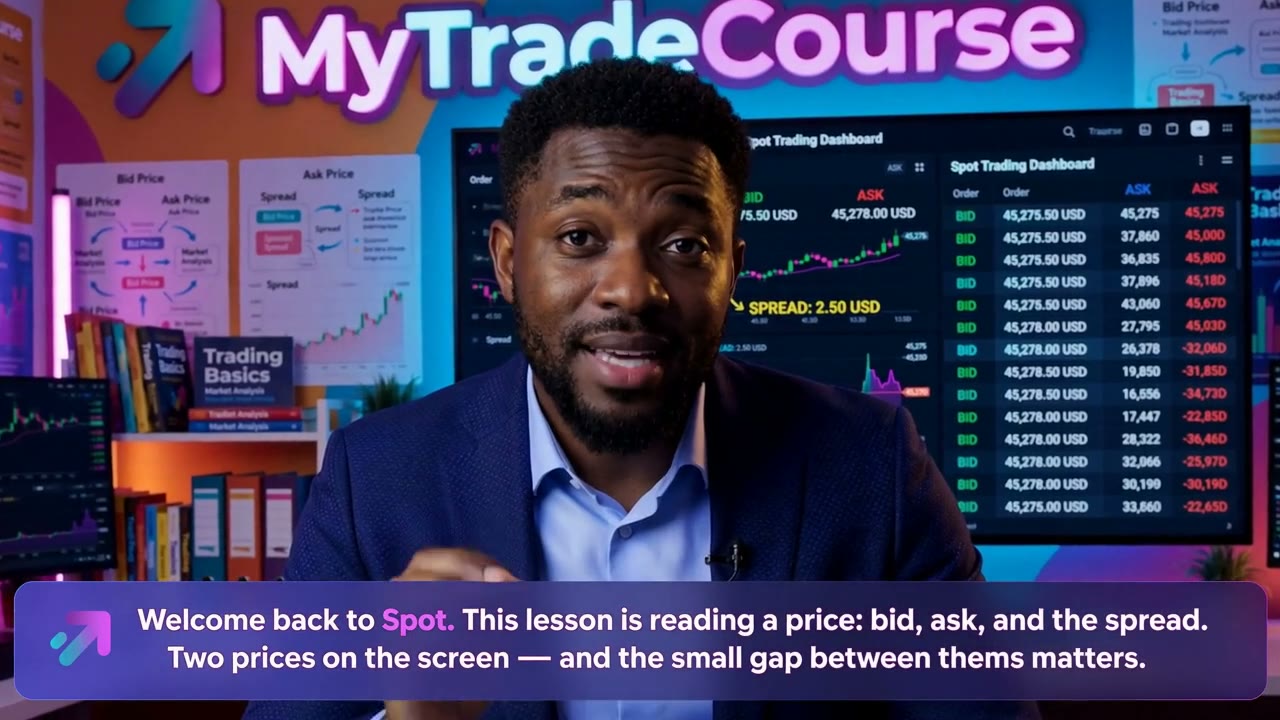
This video is part of Premium
Premium is not open yet. No Premium price is shown and nothing is charged until the owner opens it. The full lesson is below, and the audio is free right now.
Listen — free
The teacher's voice for this lesson (1:00). This lesson's audio is free.
Read the transcript
Welcome back to Spot. This lesson is reading a price: bid, ask, and the spread. Two prices on the screen — and the small gap between them matters. Every price quote shows two numbers. The bid is the highest price a buyer will pay right now. The ask is the lowest price a seller will accept right now. The spread is the gap between them. If the bid is ninety-nine and the ask is one hundred, the spread is one. That simple gap is part of every trade. A tight spread, with the bid and ask close together, usually means lots of buyers and sellers are active. A wide spread means fewer are there, so trading costs more. You buy at the ask and you sell at the bid. So you start a trade already paying the spread. Read both prices first — never just the big number in the middle. Remember: bid is what buyers offer, ask is what sellers want, and the spread is the gap between them. Now — try the quick quiz.
Two prices, always
Every market quotes two prices. The bid is the highest price a buyer is willing to pay right now; the ask is the lowest price a seller will accept. When you buy, you pay the ask. When you sell, you receive the bid. The single 'price' shown on charts is usually the last traded price or the midpoint — not necessarily the price you will get.
The spread is a real cost
The gap between bid and ask is the spread. Buy at an ask of $100.05 and immediately sell at a bid of $99.95 and you lose $0.10 per unit before price moves at all. Market makers earn that gap for standing ready to trade. Popular, heavily traded assets have razor-thin spreads; obscure ones can have spreads so wide they eat a trade before it starts.
Liquidity makes prices honest
Liquidity means many buyers and sellers competing. Deep liquidity → tight spreads and orders filled near the quoted price. Thin liquidity → wide spreads and slippage, where your fill is worse than expected. Before trading anything, check its typical spread and daily volume; they tell you how expensive it is just to get in and out.
Worked example — spread math
A coin shows bid $2.40 / ask $2.46. The spread is $0.06, about 2.5% of the price. Buy 100 coins and you pay $246; sell instantly and you receive $240. Your trade must climb roughly 2.5% just to break even. The same size trade in a major stock with a 1-cent spread on a $200 share costs about 0.005%. Instrument choice is a cost decision.
Remember this
- You buy at the ask and sell at the bid — never the headline price.
- The spread is an immediate, guaranteed cost of trading.
- High liquidity = tight spreads and reliable fills.
- Check spread and volume before entering any market.
Check what you learned
Completion marks are saved on this device only.
SEO used on this page
| Page title | Set — Reading a Price: Bid, Ask, and the Spread — Spot Trading | MyTradeCourse |
|---|---|
| Meta description | Set — Why there are always two prices, and what the gap between them costs you. |
| Share picture | Set — https://mytradecourse.com/media/thumbs/mytradecourse-spot-reading-price-lesson-thumbnail.jpg |
| Audio file | Set — /media/audio/mytradecourse-spot-reading-price-lesson-audio.mp3 |
| Video file | Set — mytradecourse-spot-reading-price-lesson.mp4 (Premium) |
| Captions | Set — /media/captions/mytradecourse-spot-reading-price-lesson-captions.vtt |
| Transcript | Set — shown on this page under Listen |
| Structured data | Set — LearningResource + VideoObject |