Trading Around News and Earnings
Spot Trading Intermediate About 5 min Audio free Video · Premium
Scheduled news reprices assets in seconds. You can trade it deliberately or be traded by it accidentally.
Watch your teacher
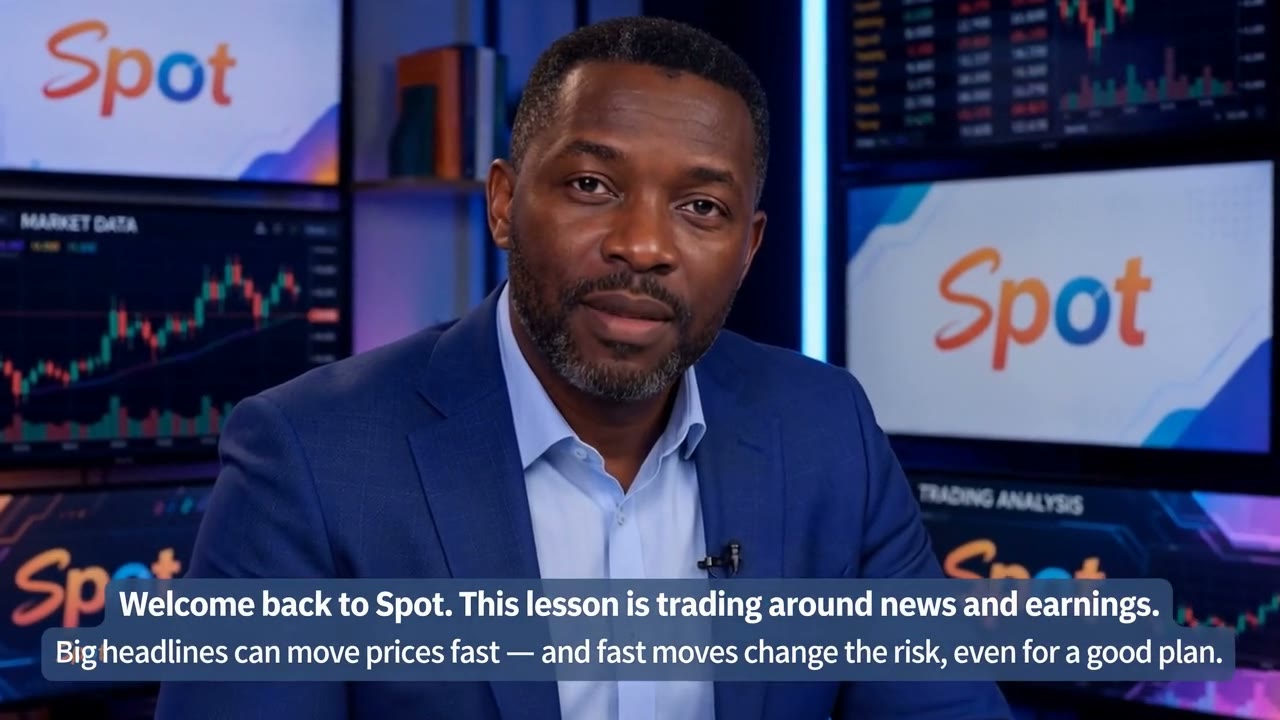
This video is part of Premium
Premium is not open yet. No Premium price is shown and nothing is charged until the owner opens it. The full lesson is below, and the audio is free right now.
Listen — free
The teacher's voice for this lesson (1:00). This lesson's audio is free.
Read the transcript
Welcome back to Spot. This lesson is trading around news and earnings. Big headlines can move prices fast — and fast moves change the risk, even for a good plan. Earnings are company report cards. A few times a year, a company shares how it did — sales, costs, and profit — and price can react within minutes of the release. Big news works the same way. An interest rate decision, a jobs report, or a surprise headline can move many prices at once, often before you have time to read the full story. Around those moments, trading gets messy. Spreads often widen, prices can jump past your order level, and a market order can fill far from the price you saw. So check the calendar first. Know what news is due and when earnings land for what you hold. If you do not fully understand the moment, standing aside is a valid plan — you do not have to trade the news. Remember: news and earnings can move price fast, widen spreads, and break a calm plan. Check the calendar first, and stand aside when unsure. Now — try the quick quiz.
Know the calendar before the market tells you
Earnings dates, central-bank decisions, inflation prints: all published in advance. The beginner's minimum standard is defensive — check the calendar before entering, and know what is scheduled while you hold. A good setup the night before an earnings report is a different trade than the same setup on a quiet Tuesday: the overnight gap risk (Lesson 7) is now a scheduled event.
Why the reaction defies the headline
Prices react to the surprise versus expectations, not to 'good' or 'bad' in the abstract. A company can report record profit and fall 10% because the market expected even more, or because guidance dimmed. Trading the headline word is betting you can out-read a priced-in expectation in seconds. Beginners are better served standing aside for the first reaction and trading the settled trend — or not trading the event at all.
Spreads and slippage around prints
In the seconds around a release, spreads widen dramatically and stops fill far from their levels — liquidity providers protect themselves. Market orders in that window are blank checks. If your plan includes holding through scheduled news, size for the gap, not the stop distance: assume the stop may fill several percent beyond its level.
Worked example — sizing for the event
A $10,000 account wants to hold a stock through earnings. Normal risk: 1% = $100, with a stop 4% away → $2,500 position. But earnings gaps of 8% are common for this name. Assuming the stop fills 9% away, a $100 risk budget allows only about $1,100 of position. Same trade, same plan — the event repriced the size.
Try it yourself
Before your next practice trade, check an economic/earnings calendar for the asset and note anything scheduled in the next 48 hours in the trade's journal entry in MyTradeDiary (free). Make calendar-checking a written step in your routine.
Remember this
- Check the calendar before entry and before holding — news dates are known in advance.
- Markets react to surprise versus expectations, not to good/bad headlines.
- Spreads explode around prints; market orders then are blank checks.
- Holding through events means sizing for the gap, not the stop.
Check what you learned
Completion marks are saved on this device only.
SEO used on this page
| Page title | Set — Trading Around News and Earnings — Spot Trading | MyTradeCourse |
|---|---|
| Meta description | Set — Scheduled news reprices assets in seconds. You can trade it deliberately or be traded by it accidentally. |
| Share picture | Set — https://mytradecourse.com/media/thumbs/mytradecourse-spot-news-earnings-lesson-thumbnail.jpg |
| Audio file | Set — /media/audio/mytradecourse-spot-news-earnings-lesson-audio.mp3 |
| Video file | Set — mytradecourse-spot-news-earnings-lesson.mp4 (Premium) |
| Captions | Set — /media/captions/mytradecourse-spot-news-earnings-lesson-captions.vtt |
| Transcript | Set — shown on this page under Listen |
| Structured data | Set — LearningResource + VideoObject |