The Wheel: Puts and Covered Calls as a System
Options Advanced About 6 min Audio free Video · Premium
Sell a cash-secured put; if assigned, sell covered calls until the shares are called away. A cycle, with real failure modes.
Watch your teacher
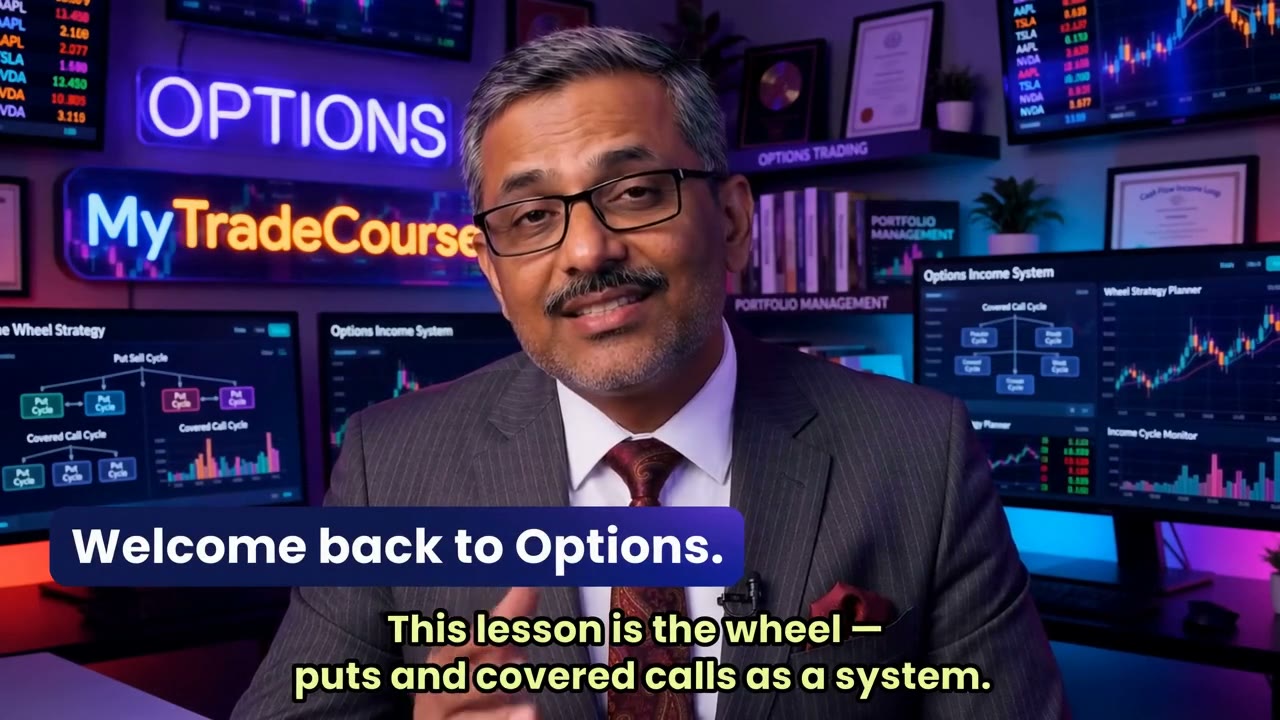
This video is part of Premium
Premium is not open yet. No Premium price is shown and nothing is charged until the owner opens it. The full lesson is below, and the audio is free right now.
Listen — free
The teacher's voice for this lesson (1:00). This lesson's audio is free.
Read the transcript
Welcome back to Options. This lesson is the wheel — puts and covered calls as a system. The wheel is a system, not a single trade. It links selling puts and selling covered calls. You follow the same steps in a loop. Step one is sell a put on a stock you would own. Collect the premium. If the put expires, you keep the premium and can sell another put. If you are assigned, you now own the shares. Step two is sell a covered call on those shares. Collect premium while you hold them. If the shares are called away, the loop restarts. You are back to selling puts. Keep size steady and journal every step. Remember — the wheel loops puts, then shares, then covered calls. Now — try the quick quiz.
The cycle
The wheel: (1) Sell a cash-secured put on a stock you'd genuinely like to own, at a strike you'd happily pay — collect premium. (2a) It expires worthless: repeat step 1. (2b) Assigned: you now own 100 shares at the strike (Lesson 14). (3) Sell a covered call above your cost — collect premium. (4a) It expires: repeat step 3. (4b) Called away: shares sold at the strike; return to step 1. Every stage collects premium; every stage is also a real stock position with real downside.
The non-negotiable entry condition
The wheel's entire safety rests on the sentence 'a stock I'd happily own at this strike.' The put is not a coupon machine that occasionally malfunctions into shares — shares are a planned outcome arriving exactly when the stock has fallen. Running the wheel on anything you wouldn't hold for a year converts an income system into a bag-holding system with small premium band-aids.
Where the wheel underperforms
Strong bull trends: repeated covered calls cap your upside while buy-and-hold runs away — the wheel trades away the right tail for premium. Crashes: puts assign all the way down and calls can only be sold below your cost (locking in losses if called) or for pennies above it. The wheel is a range-to-mildly-up system on quality names, sized so that owning the shares at the strike is a minor event for the account — judged honestly against simply owning the stock (your benchmark) in the journal.
Worked example — one honest rotation
Stock you like at $48: sell the $48 put for $1.10 (cash secured: $4,800 reserved). Assigned at $48 after a dip — effective cost $46.90 after premium. Sell the $50 call for $0.85; shares called away at $50. Rotation result per share: put premium $1.10 + stock gain $2.00 + call premium $0.85 = $3.95 on ~$4,800 over seven weeks. Respectable, mechanical, and fully dependent on the dip having been a dip — the same rotation on a stock that kept falling to $35 is a $11/share loss with $1.95 of premium sympathy.
Try it yourself
Paper-run one full wheel rotation on a stock you'd genuinely own: log the put, the assignment plan, and the call you'd sell next in MyTradeDiary (free), including the sentence 'I am happy owning this at the strike because…' — if the sentence won't write itself, the trade fails its entry condition.
Remember this
- The wheel rotates: cash-secured puts → possible assignment → covered calls → possible sale → repeat.
- Entry condition is absolute: only on stocks you'd happily own at the strike, for a year.
- It underperforms in strong rallies (capped upside) and in crashes (assignment all the way down).
- Judge it against simply owning the stock, in the journal, with all premiums counted.
Check what you learned
Completion marks are saved on this device only.
SEO used on this page
| Page title | Set — The Wheel: Puts and Covered Calls as a System — Options | MyTradeCourse |
|---|---|
| Meta description | Set — Sell a cash-secured put; if assigned, sell covered calls until the shares are called away. A cycle, with real failure modes. |
| Share picture | Set — https://mytradecourse.com/media/thumbs/mytradecourse-options-wheel-lesson-thumbnail.jpg |
| Audio file | Set — /media/audio/mytradecourse-options-wheel-lesson-audio.mp3 |
| Video file | Set — mytradecourse-options-wheel-lesson.mp4 (Premium) |
| Captions | Set — /media/captions/mytradecourse-options-wheel-lesson-captions.vtt |
| Transcript | Set — shown on this page under Listen |
| Structured data | Set — LearningResource + VideoObject |