Rolling a Trade: When It Helps, When It Hurts
Options Advanced About 5 min Audio free Video · Premium
Rolling closes one option and opens another in a single order. It is a new trade wearing the old trade's clothes.
Watch your teacher
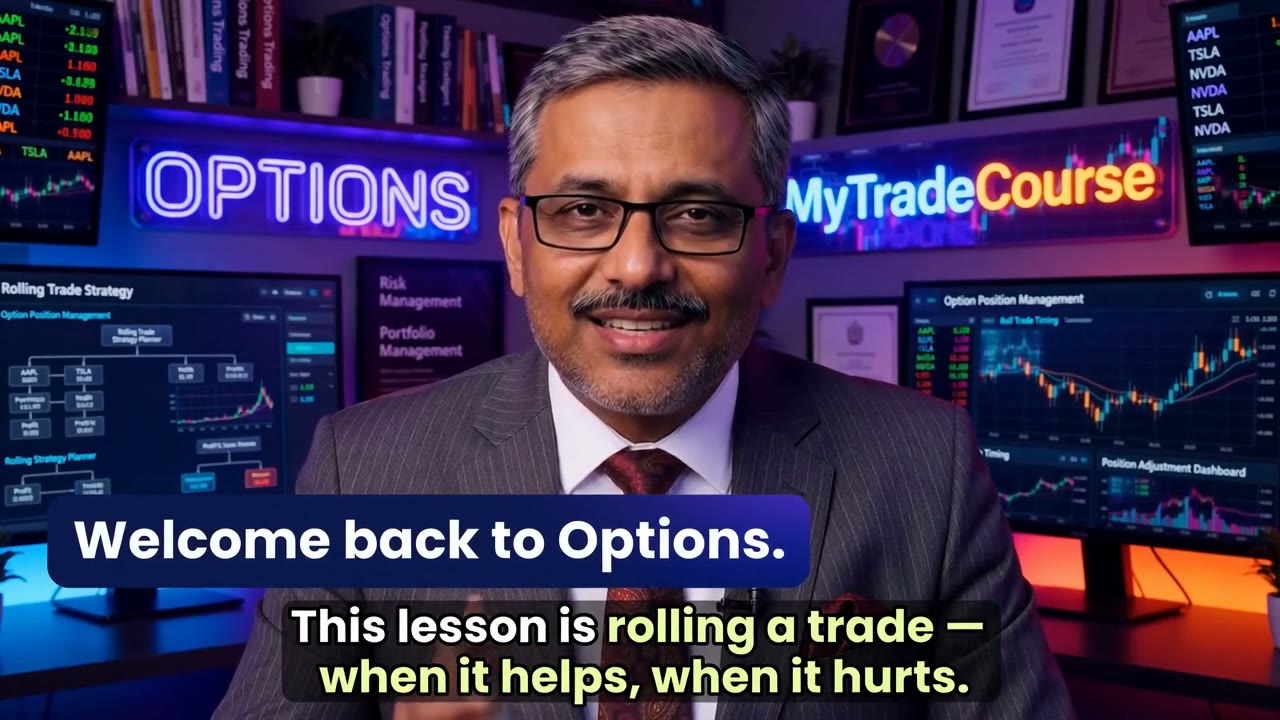
This video is part of Premium
Premium is not open yet. No Premium price is shown and nothing is charged until the owner opens it. The full lesson is below, and the audio is free right now.
Listen — free
The teacher's voice for this lesson (1:00). This lesson's audio is free.
Read the transcript
Welcome back to Options. This lesson is rolling a trade — when it helps, when it hurts. Rolling means closing one option and opening another. You close the first trade. You open a new one with a later expiry. Traders roll for more time. The new expiry gives the idea more time. It does not erase the loss on the first trade. Rolling can help when your plan is still sound. The setup still fits. You just need more time at a managed size. Rolling hurts when it just avoids a loss. Adding size to save a bad trade grows risk. If the plan is broken, closing is cleaner. Remember — roll for time with a sound plan, not to dodge a loss. Now — try the quick quiz.
What rolling is, mechanically
To roll, you buy back your short (or sell your long) and simultaneously open a new position — later expiry ('out'), different strike ('up'/'down'), or both — as one spread order for a net credit or debit. Brokers present it as one click, which disguises the truth: leg one realizes the current trade's result, finally and completely; leg two is a brand-new trade that must justify itself on its own merits.
When rolling is legitimate
Defined-purpose rolls: a covered-call writer whose thesis is unchanged rolls out (and maybe up) to keep income and stock; a put-spread seller at their pre-set adjustment alarm (Lesson 11) rolls the threatened spread away for a small debit or credit, per rules written at entry; a long call holder whose catalyst moved a month rolls out BEFORE theta accelerates. Each case shares: the rule existed in advance, the new trade passes today's entry criteria, and the total risk stays within plan.
When rolling is a loss in denial
The pathological pattern: a losing defined-risk spread gets rolled for 'a credit' again and again, each time wider or larger, converting a capped $300 lesson into an uncapped saga. Diagnostic questions: would I open this new position fresh, at this size, if I had no history here? Does the roll increase max loss or duration beyond the original plan? Am I rolling to avoid writing the loss in the journal? A 'yes' to the last two ends the roll. Realize, record, review — Foundations' loop exists precisely for this moment.
Worked example — two rolls, two verdicts
Roll A: covered call, stock strong, thesis intact, roll out-and-up collects $0.60 more credit and raises the sale price by $2 — a planned income mechanic. Verdict: legitimate. Roll B: a $5-wide put spread, max loss $340, is down $260; the trader rolls it to next month doubling to 2 contracts 'for a $0.20 credit' — new max loss $880, opened solely because the old trade hurt. Verdict: a fresh, bigger bet placed by a loss. The journal grades B as a rule break regardless of outcome.
Remember this
- A roll closes the old trade (realizing its result) and opens a new one — judge the new one fresh.
- Legitimate rolls follow rules written at entry and keep total risk inside the plan.
- Rolling to avoid recording a loss converts capped lessons into uncapped sagas.
- The test: 'Would I open this exact position today, at this size, with no history?'
Check what you learned
Completion marks are saved on this device only.
SEO used on this page
| Page title | Set — Rolling a Trade: When It Helps, When It Hurts — Options | MyTradeCourse |
|---|---|
| Meta description | Set — Rolling closes one option and opens another in a single order. It is a new trade wearing the old trade's clothes. |
| Share picture | Set — https://mytradecourse.com/media/thumbs/mytradecourse-options-rolling-lesson-thumbnail.jpg |
| Audio file | Set — /media/audio/mytradecourse-options-rolling-lesson-audio.mp3 |
| Video file | Set — mytradecourse-options-rolling-lesson.mp4 (Premium) |
| Captions | Set — /media/captions/mytradecourse-options-rolling-lesson-captions.vtt |
| Transcript | Set — shown on this page under Listen |
| Structured data | Set — LearningResource + VideoObject |