Iron Condors: Defined-Risk Range Trades
Options Advanced About 6 min Audio free Video · Premium
Sell a put spread and a call spread around a range-bound stock. You are renting out both tails — with caps.
Watch your teacher
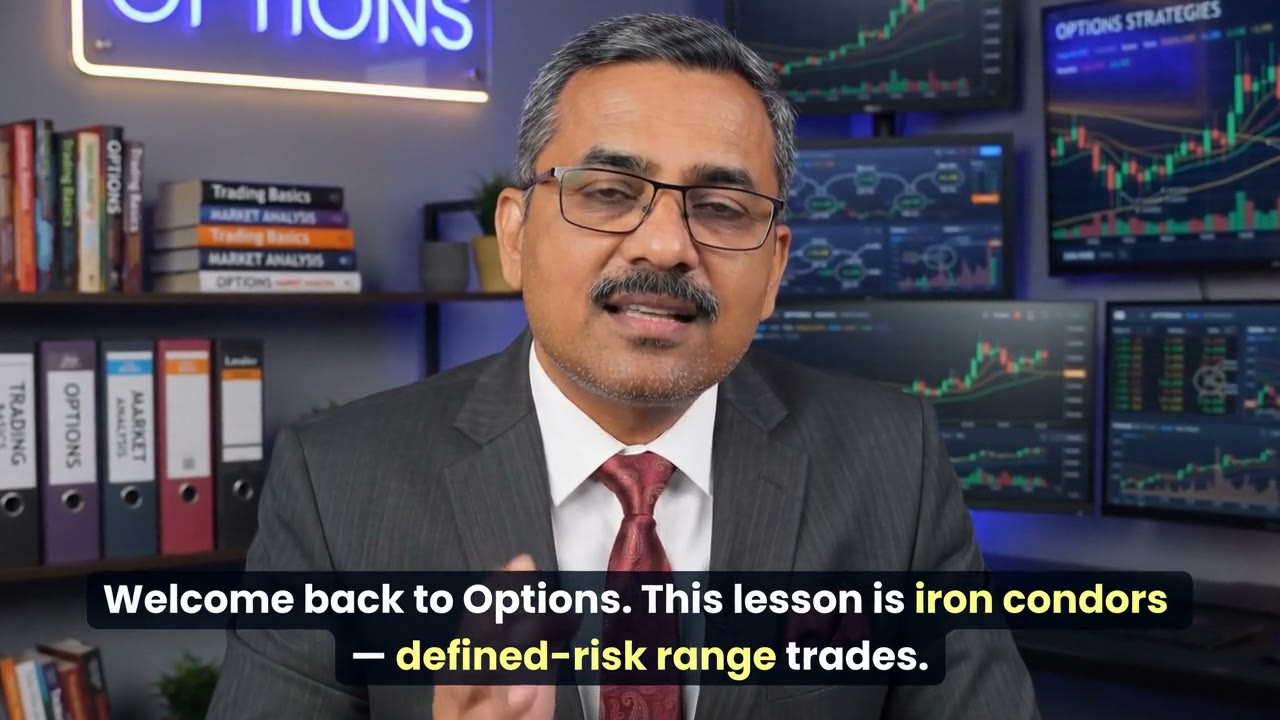
This video is part of Premium
Premium is not open yet. No Premium price is shown and nothing is charged until the owner opens it. The full lesson is below, and the audio is free right now.
Listen — free
The teacher's voice for this lesson (1:00). This lesson's audio is free.
Read the transcript
Welcome back to Options. This lesson is iron condors — defined-risk range trades. An iron condor uses four options at once. You sell two options closer to price. You buy two farther options for protection. The sold options form a range. If price stays inside that range, time decay can help the trade. The premium received is the most you can gain. The bought options set the limit. They cap the worst loss on each side. That cap is why the risk is defined. Check the plan before you trade. All four legs share one expiry. Set your strikes, your size, and your exit first. Remember — iron condors trade a range with defined risk. Now — try the quick quiz.
The structure
An iron condor combines Lesson 5's tools: sell an out-of-the-money put and buy a further-out put (a put credit spread) below price; sell an out-of-the-money call and buy a further-out call (a call credit spread) above price. Net premium collected up front. You profit fully if price expires between the short strikes; the long wings cap the loss beyond them. Four legs, one order on most platforms, defined risk on both sides.
The math template
Example: stock $100. Sell the 92.5 put / buy the 90 put; sell the 107.5 call / buy the 110 call; collect $1.20 total credit per share ($120 per condor). Max loss per side = width − credit = 2.50 − 1.20 = $1.30 ($130). Both sides can't lose fully at once — price settles in one place. Reward:risk ≈ 120:130, with a high probability of keeping something — the seller's profile from Lesson 8, engineered with training wheels.
Management is the strategy
Condors are usually managed, not held to expiry: common rules take profit at 50% of max credit, and cut or adjust when a short strike is seriously tested (delta of a short leg reaching ~0.30 is a popular alarm). Best environments: high IV rank (Lesson 9) on range-bound, liquid underlyings with no binary event inside the trade window. Worst: right before earnings on a stock with a habit of 12% gaps — the wings cap loss, they don't prevent it.
Worked example — a managed month
Condor opened for $1.20 credit, 30 days out. By day 12, price sits mid-range and the condor's value has decayed to $0.55 — the 50% rule triggers: buy back for $0.55, keep $0.65 per share ($65 per condor), and free the capital and the risk for the remaining 18 days. Held to expiry it might have kept the last $0.55 too — at the price of 18 more days of gap risk. The rule trades tail dollars for certainty and turnover.
Try it yourself
Paper-trade one iron condor on a liquid index ETF after checking its IV rank: write the four strikes, credit, max loss, 50% profit target, and adjustment alarm in MyTradeDiary (free) before placing the paper order.
Remember this
- A condor = put credit spread + call credit spread; wings cap both tails.
- Max loss = spread width − credit; reward:risk near 1:1 with a high partial-win rate.
- Management rules (50% profit take, delta alarms) are part of the strategy, not garnish.
- Needs range-bound, liquid, event-free windows and preferably rich IV.
Check what you learned
Completion marks are saved on this device only.
SEO used on this page
| Page title | Set — Iron Condors: Defined-Risk Range Trades — Options | MyTradeCourse |
|---|---|
| Meta description | Set — Sell a put spread and a call spread around a range-bound stock. You are renting out both tails — with caps. |
| Share picture | Set — https://mytradecourse.com/media/thumbs/mytradecourse-options-iron-condor-lesson-thumbnail.jpg |
| Audio file | Set — /media/audio/mytradecourse-options-iron-condor-lesson-audio.mp3 |
| Video file | Set — mytradecourse-options-iron-condor-lesson.mp4 (Premium) |
| Captions | Set — /media/captions/mytradecourse-options-iron-condor-lesson-captions.vtt |
| Transcript | Set — shown on this page under Listen |
| Structured data | Set — LearningResource + VideoObject |