Liquidity and the Order Book in Futures
Futures Beginner About 5 min Audio free Video · Premium
Futures trade on a central exchange with a visible order book. Depth tells you what your order will really cost.
Watch your teacher
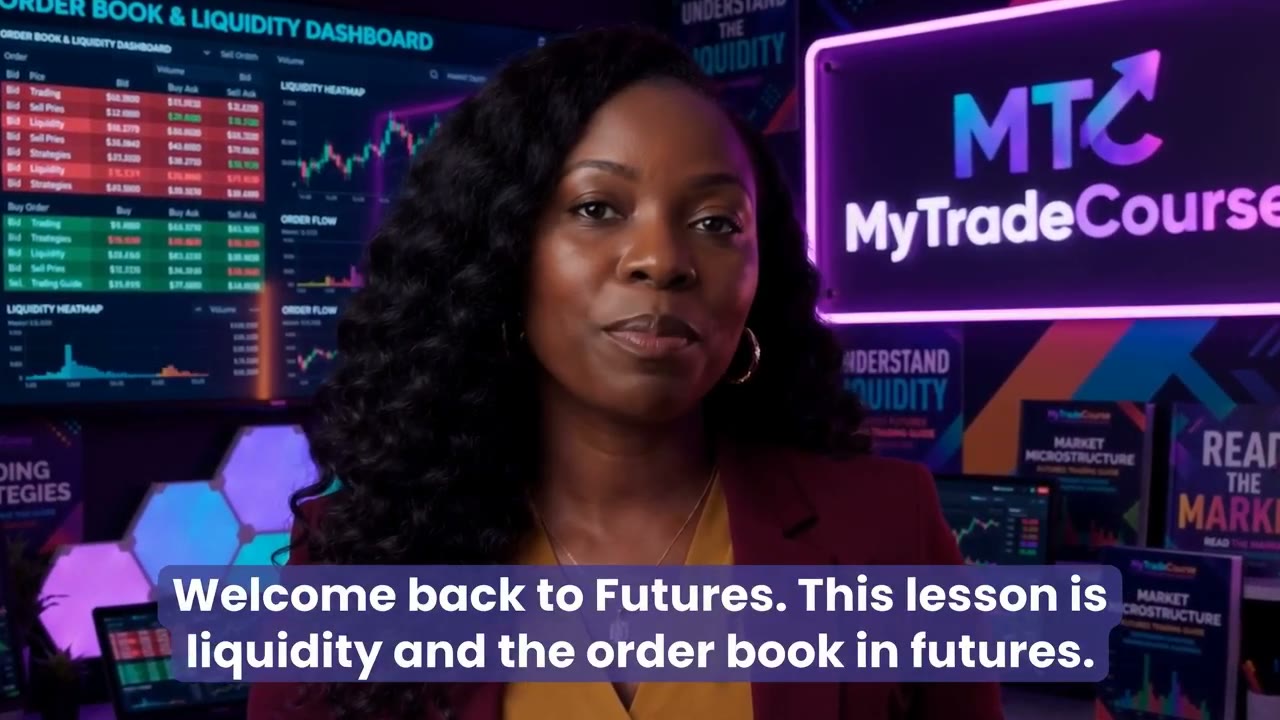
This video is part of Premium
Premium is not open yet. No Premium price is shown and nothing is charged until the owner opens it. The full lesson is below, and the audio is free right now.
Listen — free
The teacher's voice for this lesson (1:00). This lesson's audio is free.
Read the transcript
Welcome back to Futures. This lesson is liquidity and the order book in futures. Liquidity is how easily you can trade — and the order book shows you why. Liquidity means how easily you can buy or sell without moving the price much. A liquid futures market has many buyers and sellers active, so orders fill quickly and close to the price you see. The order book is the live list behind the price. On one side are bids — prices buyers are willing to pay, with how many contracts. On the other side are offers — prices sellers are asking, and how many. Depth is how much is waiting at each price. A deep book has many contracts stacked at prices near the top. A thin book has only a few, so one larger order can push through several prices at once. Read it before you trade: a tight spread between the best bid and best offer, plus good depth, usually means an active, liquid market. A wide spread and a thin book warn you that fills can slip and cost more than you planned. Remember: liquidity is ease of trading, the order book lists the bids and offers waiting, and depth shows how much is really there. Now — try the quick quiz.
One market, one book
Unlike forex's fragmented quotes, futures trade on centralized exchanges (CME and others) where every bid and offer sits in one order book. The top of book shows the best bid and ask and how many contracts rest at each. When you see 'bid 2,431.25 × 84,' eighty-four contracts are willing to buy there — your market order for 2 fills instantly; an order for 200 would walk through several price levels.
Depth, slippage, and size
Slippage in futures is mostly a depth problem: thin overnight books mean a stop for size fills across multiple ticks. The front month of a major index future might show hundreds of contracts per tick at midday and five per tick at 3 a.m. Same contract, different market. Match your size and your hours to the book you can actually see.
Front month carries the crowd
Liquidity concentrates in the nearest active contract month and migrates as expiry approaches (the roll, Lesson 3). Distant months often show wide spreads and sparse books even in famous markets. Beginners belong in the front month, in the busy hours, until depth-reading is second nature.
Worked example — the 3 a.m. stop
Overnight, a book shows 4 contracts bid at the stop level, 3 at the next tick, then a 4-tick gap to the next bid. A 10-lot stop-market order fills: 4 at the stop, 3 one tick through, 3 five ticks through — average slippage over 2 ticks per contract. At midday the same order fills at one price. The stop 'failed' only in the sense that the market it hit was nearly empty.
Remember this
- Futures have one central book — you can see the depth your order will consume.
- Slippage is largely a depth-and-hour problem; thin books punish size and stops.
- Trade the front month in busy hours while learning; liquidity is a feature, not a detail.
Check what you learned
Completion marks are saved on this device only.
SEO used on this page
| Page title | Set — Liquidity and the Order Book in Futures — Futures | MyTradeCourse |
|---|---|
| Meta description | Set — Futures trade on a central exchange with a visible order book. Depth tells you what your order will really cost. |
| Share picture | Set — https://mytradecourse.com/media/thumbs/mytradecourse-futures-liquidity-lesson-thumbnail.jpg |
| Audio file | Set — /media/audio/mytradecourse-futures-liquidity-lesson-audio.mp3 |
| Video file | Set — mytradecourse-futures-liquidity-lesson.mp4 (Premium) |
| Captions | Set — /media/captions/mytradecourse-futures-liquidity-lesson-captions.vtt |
| Transcript | Set — shown on this page under Listen |
| Structured data | Set — LearningResource + VideoObject |