Reading a Forex Quote, Pipettes, and the Spread
Forex Beginner About 4 min Audio free Video · Premium
Five decimals, a fractional pip, and why the spread is quoted in the price itself.
Watch your teacher
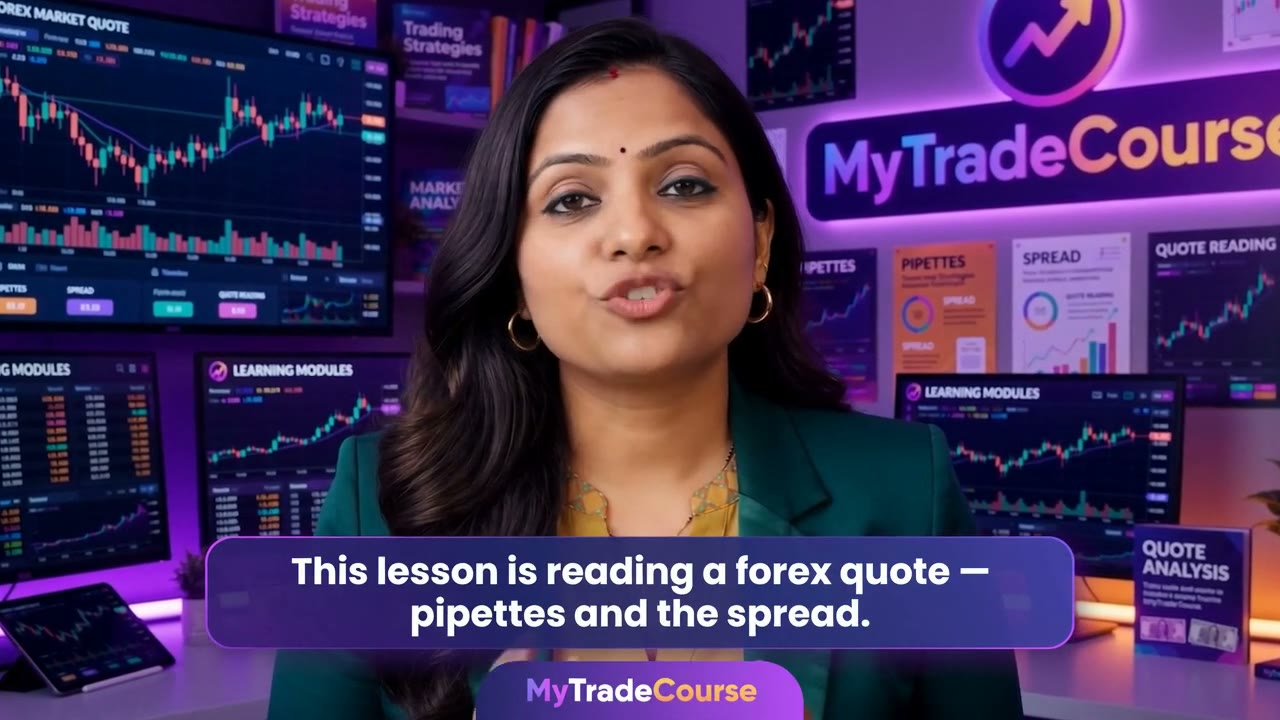
This video is part of Premium
Premium is not open yet. No Premium price is shown and nothing is charged until the owner opens it. The full lesson is below, and the audio is free right now.
Listen — free
The teacher's voice for this lesson (1:00). This lesson's audio is free.
Read the transcript
Welcome back to Forex. This lesson is reading a forex quote — pipettes and the spread. A forex quote shows two prices for one pair. The bid is what buyers will pay. The ask is what sellers will accept. The spread is the gap between bid and ask. You buy at the ask. You sell at the bid. That gap is part of every trade cost. A pipette is one tenth of a pip. It is the fifth decimal place on most pairs. It lets the quote show smaller price steps. Read a quote in order. Name the pair first. Then read bid, ask, and spread. A tight spread costs less than a wide one. Remember — read the pair, bid, ask, and spread first. Now — try the quick quiz.
The anatomy of a quote
EUR/USD at 1.08532 / 1.08547: the first number is the bid (you sell here), the second the ask (you buy here). The difference — 0.00015, or 1.5 pips — is the spread, your entry toll. The fifth decimal (the '2' and '7') is a pipette, a tenth of a pip, added by brokers for finer pricing. Most charting in pips, most confusion in pipettes: when your platform shows a 15-point move, that is 1.5 pips.
Which currency are you actually trading?
A pair is a ratio: EUR/USD rising means the euro strengthens against the dollar (or the dollar weakens — the quote cannot tell you which). That ambiguity matters for news: EUR/USD can rally on dollar weakness with nothing happening in Europe at all. Always ask which leg is moving before telling yourself a story about the trade.
Spreads breathe
Major-pair spreads are tightest in the London–New York overlap and widest at the daily rollover and around news (Lesson 4's sessions). A pair quoted at 0.8 pips at 10:00 may be 4 pips at 22:00. Your backtests and your stop distances must use the spread of the hour you actually trade.
Worked example — the toll on a scalp
A short-term trader targets 6 pips on EUR/USD during a quiet hour when the spread is 2.5 pips. Over 40% of the target is consumed by the toll before slippage — the trade must be right about direction and timing just to keep a fraction. The same target in the London open at a 0.7-pip spread keeps over 85% of the move available. Session choice is a strategy variable.
Remember this
- Bid/ask, spread in pips, fifth decimal = pipette (a tenth of a pip).
- A rising pair can mean base strength OR quote weakness — ask which leg moved.
- Spreads vary several-fold by hour; size and test with your session's real spread.
Check what you learned
Completion marks are saved on this device only.
SEO used on this page
| Page title | Set — Reading a Forex Quote, Pipettes, and the Spread — Forex | MyTradeCourse |
|---|---|
| Meta description | Set — Five decimals, a fractional pip, and why the spread is quoted in the price itself. |
| Share picture | Set — https://mytradecourse.com/media/thumbs/mytradecourse-forex-quote-lesson-thumbnail.jpg |
| Audio file | Set — /media/audio/mytradecourse-forex-quote-lesson-audio.mp3 |
| Video file | Set — mytradecourse-forex-quote-lesson.mp4 (Premium) |
| Captions | Set — /media/captions/mytradecourse-forex-quote-lesson-captions.vtt |
| Transcript | Set — shown on this page under Listen |
| Structured data | Set — LearningResource + VideoObject |