Liquidations and Cascade Wicks
Crypto Intermediate About 5 min Audio free Video · Premium
Leveraged longs and shorts forced to exit at market, in a chain reaction. The anatomy of crypto's ugliest candles.
Watch your teacher
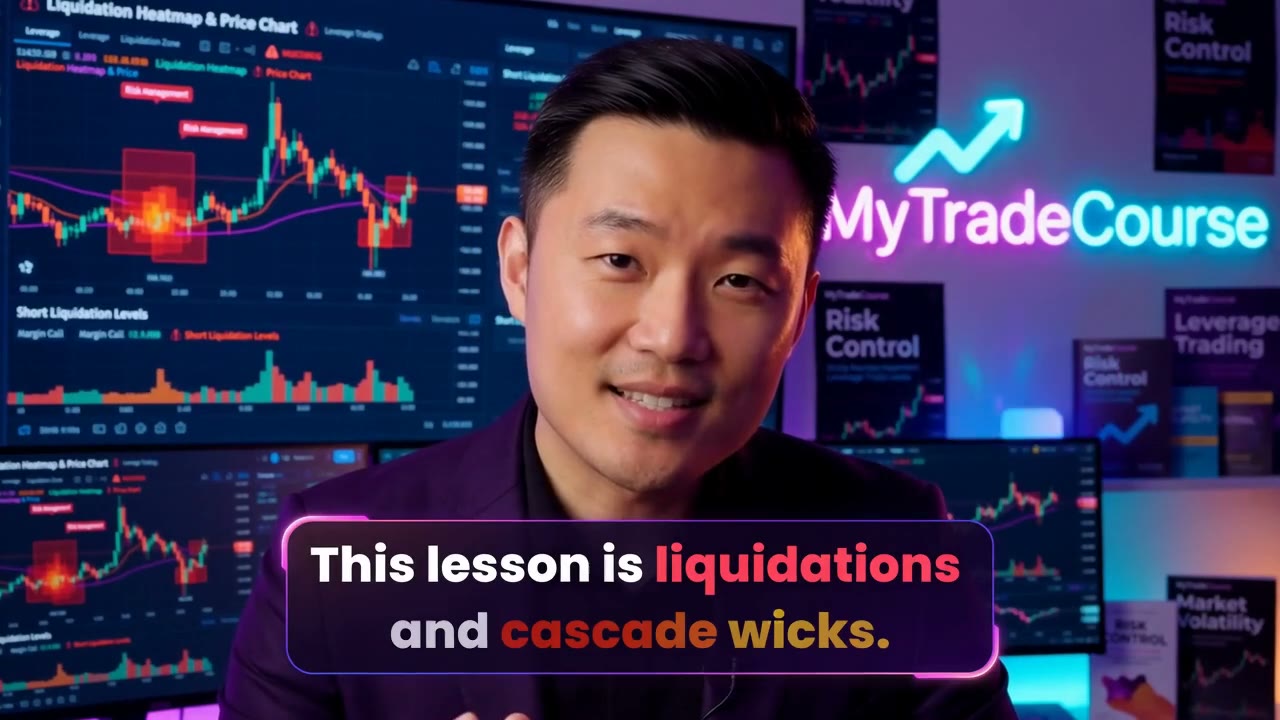
This video is part of Premium
Premium is not open yet. No Premium price is shown and nothing is charged until the owner opens it. The full lesson is below, and the audio is free right now.
Listen — free
The teacher's voice for this lesson (1:00). This lesson's audio is free.
Read the transcript
Welcome back to Crypto. This lesson is liquidations and cascade wicks. A liquidation is a forced close by the exchange. It happens when a leveraged position loses too much. The exchange closes it to limit the loss. Leverage makes liquidation closer. A small move against a large position uses margin fast. When margin runs low, the position can be closed for you. A cascade is a chain reaction. One liquidation pushes price further. That push triggers more liquidations. Price can fall or rise in sharp steps. That chain makes a cascade wick. The chart shows a long, sudden spike. Then price often snaps back. Protect yourself with small size and a clear stop. Remember — liquidations are forced closes, and cascades chain them together. Now — try the quick quiz.
The mechanism
A leveraged position near its liquidation price gets closed by the exchange automatically (Lesson 3): the exit is a market order, indifferent to price. That order pushes price further, reaching the next cluster of liquidation levels, whose forced orders push it further still. Longs liquidate into falling markets and shorts into rising ones (a 'short squeeze' is the upward cascade). The result: vertical wicks that travel 5–15% in minutes and then partially retrace, having transferred money from the leveraged to the patient.
Where cascades live
Liquidation levels cluster where leverage entered: around recent highs/lows, round numbers, and after days of one-sided positioning funded by extreme funding rates (Lesson 3's tell: when longs pay heavily for the privilege, the crowd is leaning one way over a trapdoor). Open interest — the total stock of outstanding contracts — is the fuel gauge: price rising on ballooning open interest means fresh leverage is piling in; cascades need fuel.
Defenses, in order
(1) Don't be the fuel: isolated margin (Lesson 3), modest leverage, size set so your liquidation price is far beyond your stop. (2) Respect the setup: initiating fresh leverage into extreme funding and record open interest is buying a ticket in the cascade. (3) If unleveraged, cascades are opportunity-shaped but knife-like: scale-in limit orders at pre-planned levels (Spot Lesson 17) or simply let them pass — catching the exact wick is a lottery, harvesting the volatility afterward at normal spreads is a strategy.
Worked example — anatomy of a flush
Bitcoin has risen for nine days; funding is the highest in months; open interest is at a record. A routine −2% dip reaches the first liquidation cluster: forced selling adds −3% in ten minutes, tripping the next cluster near a round number; total travel −9% before buyers appear. Price retraces half within the hour. Spot holders who did nothing are down 4.5% and fine. The 10× longs at three separate levels are gone entirely — same candle, three different events depending on leverage.
Try it yourself
Find a past cascade candle on a major pair. In MyTradeDiary (free), note the funding rate and open interest behavior in the days before it (your exchange's history pages show both) and write the two warning signs you would watch for next time.
Remember this
- Cascades are forced market orders triggering each other — leverage liquidating leverage.
- Fuel gauges: extreme funding, record open interest, clustered entries at obvious levels.
- Defense is pre-positioning: isolated margin, modest size, liquidation far beyond the stop.
- For the unleveraged, cascades are weather to survive first and opportunities second.
Check what you learned
Completion marks are saved on this device only.
SEO used on this page
| Page title | Set — Liquidations and Cascade Wicks — Crypto | MyTradeCourse |
|---|---|
| Meta description | Set — Leveraged longs and shorts forced to exit at market, in a chain reaction. The anatomy of crypto's ugliest candles. |
| Share picture | Set — https://mytradecourse.com/media/thumbs/mytradecourse-crypto-liquidations-lesson-thumbnail.jpg |
| Audio file | Set — /media/audio/mytradecourse-crypto-liquidations-lesson-audio.mp3 |
| Video file | Set — mytradecourse-crypto-liquidations-lesson.mp4 (Premium) |
| Captions | Set — /media/captions/mytradecourse-crypto-liquidations-lesson-captions.vtt |
| Transcript | Set — shown on this page under Listen |
| Structured data | Set — LearningResource + VideoObject |