Perpetual Futures and Funding Rates
Crypto Intermediate About 6 min Audio free Video · Premium
Crypto's favorite derivative: a future that never expires, kept honest by funding payments.
Watch your teacher
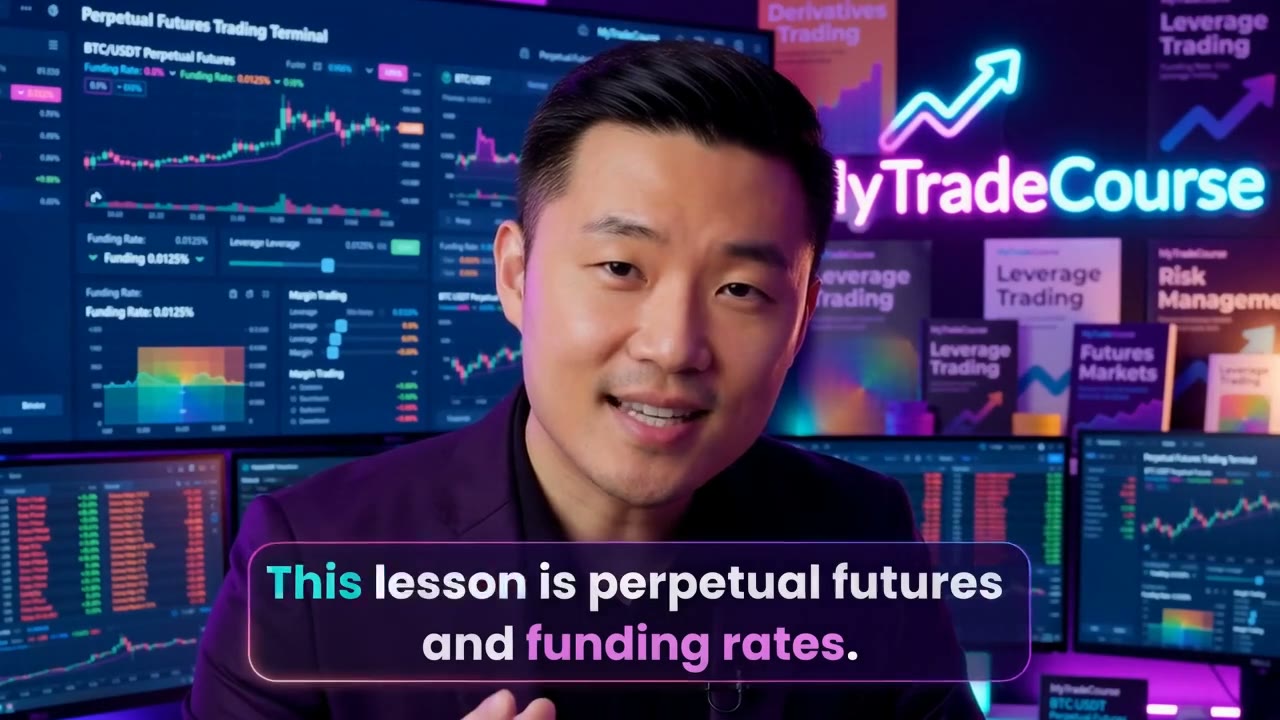
This video is part of Premium
Premium is not open yet. No Premium price is shown and nothing is charged until the owner opens it. The full lesson is below, and the audio is free right now.
Listen — free
The teacher's voice for this lesson (1:00). This lesson's audio is free.
Read the transcript
Welcome back to Crypto. This lesson is perpetual futures and funding rates. A perpetual future is a futures contract with no expiry date. Traders call it a perp for short. You can hold it without a set end date. Because there is no expiry, price needs another anchor. Funding is that anchor. It helps keep the perp price close to the spot price. Funding is a periodic payment between traders. If the perp price sits above spot, longs pay shorts. If it sits below spot, shorts pay longs. Check funding before you hold. A high funding rate is an added cost each period. That cost adds up while you hold the position. Remember — perps have no expiry, and funding keeps them tied to spot. Now — try the quick quiz.
A future with no expiry
Perpetual swaps ('perps') are futures contracts with no expiration date, traded on most crypto venues with high leverage. Because there is no settlement date to pull price toward spot, perps use a different anchor: the funding rate. Perp prices track the spot index closely, and funding handles the small persistent gaps.
Funding: the seesaw payment
Every funding interval (often 8 hours), one side pays the other. When perps trade above spot (crowded longs), funding is positive: longs pay shorts. When below, shorts pay longs. The payment is a percentage of position value — small per interval, but it compounds, and at extremes it can reach levels that punish crowded trades hard.
Liquidation is the real stop-out
Crypto venues liquidate leveraged positions automatically when margin runs out — fast, mechanical, and often worse than a planned stop because volatility spikes trigger cascades of forced selling or buying ('liquidation cascades'). Cross margin risks the whole account on one position; isolated margin fences the risk per position. Most beginners who blow up in crypto do it here, not in spot.
Worked example — funding adds up
You hold a $20,000 long perp through a week of hot markets with funding averaging +0.05% per 8-hour interval. That's 21 intervals × 0.05% × $20,000 ≈ $210 paid — over 1% of the position — even if price never moves. Funding is a carrying cost exactly like forex swap, only bigger and faster.
Remember this
- Perps never expire; funding payments anchor them to spot.
- Positive funding: longs pay shorts. Crowded side pays.
- Funding compounds — check it before holding through intervals.
- Liquidation is automatic and brutal; isolated margin fences risk.
Check what you learned
Completion marks are saved on this device only.
SEO used on this page
| Page title | Set — Perpetual Futures and Funding Rates — Crypto | MyTradeCourse |
|---|---|
| Meta description | Set — Crypto's favorite derivative: a future that never expires, kept honest by funding payments. |
| Share picture | Set — https://mytradecourse.com/media/thumbs/mytradecourse-crypto-perps-lesson-thumbnail.jpg |
| Audio file | Set — /media/audio/mytradecourse-crypto-perps-lesson-audio.mp3 |
| Video file | Set — mytradecourse-crypto-perps-lesson.mp4 (Premium) |
| Captions | Set — /media/captions/mytradecourse-crypto-perps-lesson-captions.vtt |
| Transcript | Set — shown on this page under Listen |
| Structured data | Set — LearningResource + VideoObject |