Risk Management and Position Sizing
Spot Trading Advanced About 7 min Audio free Video · Premium
The skill that decides who survives: risk a fixed small slice, size from the stop, think in R.
Watch your teacher
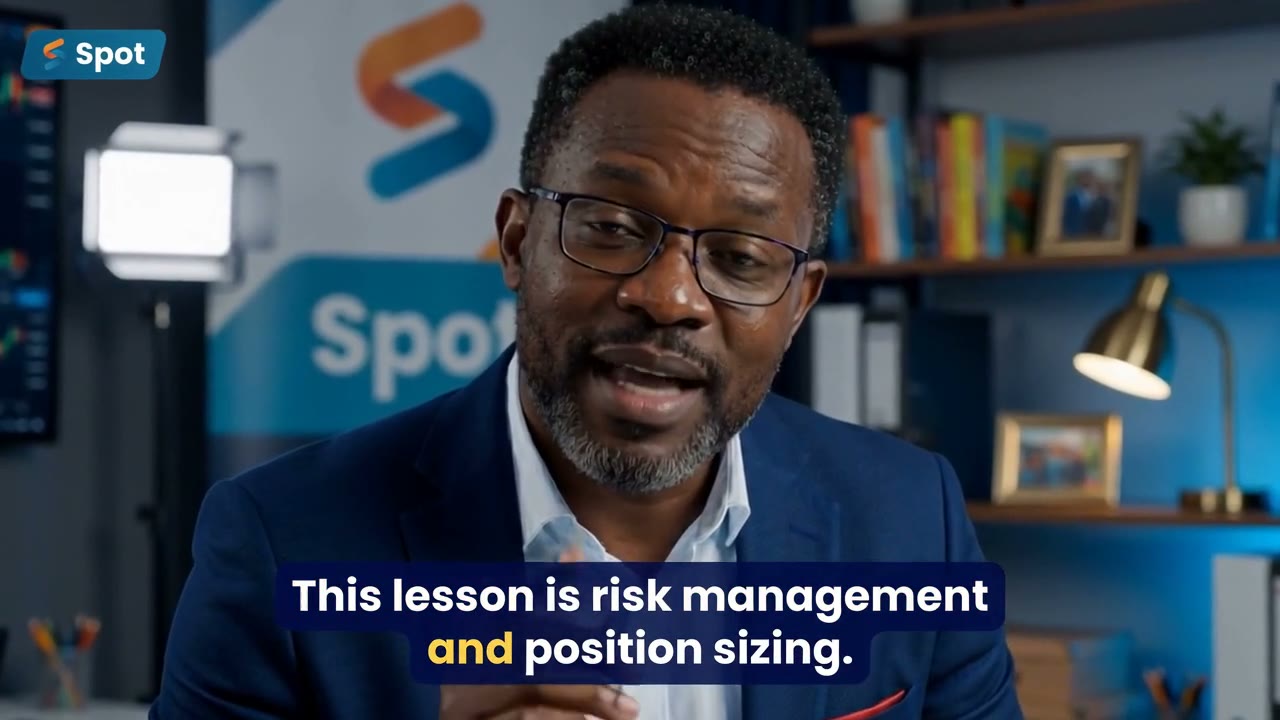
This video is part of Premium
Premium is not open yet. No Premium price is shown and nothing is charged until the owner opens it. The full lesson is below, and the audio is free right now.
Listen — free
The teacher's voice for this lesson (1:00). This lesson's audio is free.
Read the transcript
Welcome back to Spot. This lesson is risk management and position sizing. How much you risk on one trade matters more than picking the perfect entry. Risk management starts before you enter. Decide the most you are willing to lose on this one idea if it goes wrong, and write that number down first. Position size is how many units you buy. It connects your risk number to your stop. If your stop is far away, you buy fewer units. If your stop is closer, you can buy a little more — the risk stays the same. A simple example in plain numbers. If you plan to risk ten units of money and your stop is two units of price away per share, you can buy five shares. Ten divided by two is five — that is position sizing. Never size from excitement or confidence. Size from the plan every time, keep each trade's risk small and consistent, and one loss stays a normal loss, not a disaster. Remember: decide your risk first, let the distance to your stop set your size, and keep it consistent. Now — try the quick quiz.
Risk per trade: the 1% anchor
Professionals define risk before return. A common anchor: risk no more than 1% of your account on any single trade. On a $10,000 account that is $100 — if the stop is hit, you lose $100 and live to trade 100 more times. Risk 10% per trade instead, and five losers in a row — an ordinary streak — cuts your account nearly in half.
Size from the stop, not from confidence
Position size = risk amount ÷ distance from entry to stop. If you risk $100 and your stop is $2 below entry, you buy 50 units. A wider stop means a smaller position, automatically. This inverts beginner thinking: confidence does not set size; the distance to being proven wrong does.
Think in R and respect expectancy
Traders measure outcomes in R — multiples of the amount risked. A system that wins 40% of the time at +2.5R and loses 60% at −1R still profits: (0.4 × 2.5) − (0.6 × 1) = +0.4R per trade. Win rate alone means nothing without payoff size. Journal every trade with its R result — your journal is where expectancy becomes visible. Log each practice trade in MyTradeDiary (free) so the record builds itself as you learn.
Worked example — sizing a trade
Account: $25,000. Risk 1% = $250. You want to buy at $120 with a stop at $114 — $6 of risk per share. Position = 250 ÷ 6 ≈ 41 shares, costing about $4,920. Hit the target at $138 (+$18) and you gain 41 × $18 = $738 = roughly +3R. Every number was decided before entry.
Try it yourself
Size one practice position with the formula, take it on a demo or paper account, and log this practice trade in MyTradeDiary (free) — entry, stop, and the R result — before you change anything about the system.
Remember this
- Risk a fixed small fraction (about 1%) per trade.
- Position size = risk amount ÷ stop distance.
- Judge systems by expectancy in R, not win rate alone.
- Journal every trade; patterns only appear in records.
Check what you learned
Completion marks are saved on this device only.
SEO used on this page
| Page title | Set — Risk Management and Position Sizing — Spot Trading | MyTradeCourse |
|---|---|
| Meta description | Set — The skill that decides who survives: risk a fixed small slice, size from the stop, think in R. |
| Share picture | Set — https://mytradecourse.com/media/thumbs/mytradecourse-spot-risk-management-lesson-thumbnail.jpg |
| Audio file | Set — /media/audio/mytradecourse-spot-risk-management-lesson-audio.mp3 |
| Video file | Set — mytradecourse-spot-risk-management-lesson.mp4 (Premium) |
| Captions | Set — /media/captions/mytradecourse-spot-risk-management-lesson-captions.vtt |
| Transcript | Set — shown on this page under Listen |
| Structured data | Set — LearningResource + VideoObject |