Going Long and Short Selling
Spot Trading Intermediate About 6 min Audio free Video · Premium
Profiting from falls means borrowing — and borrowing changes the risk completely.
Watch your teacher
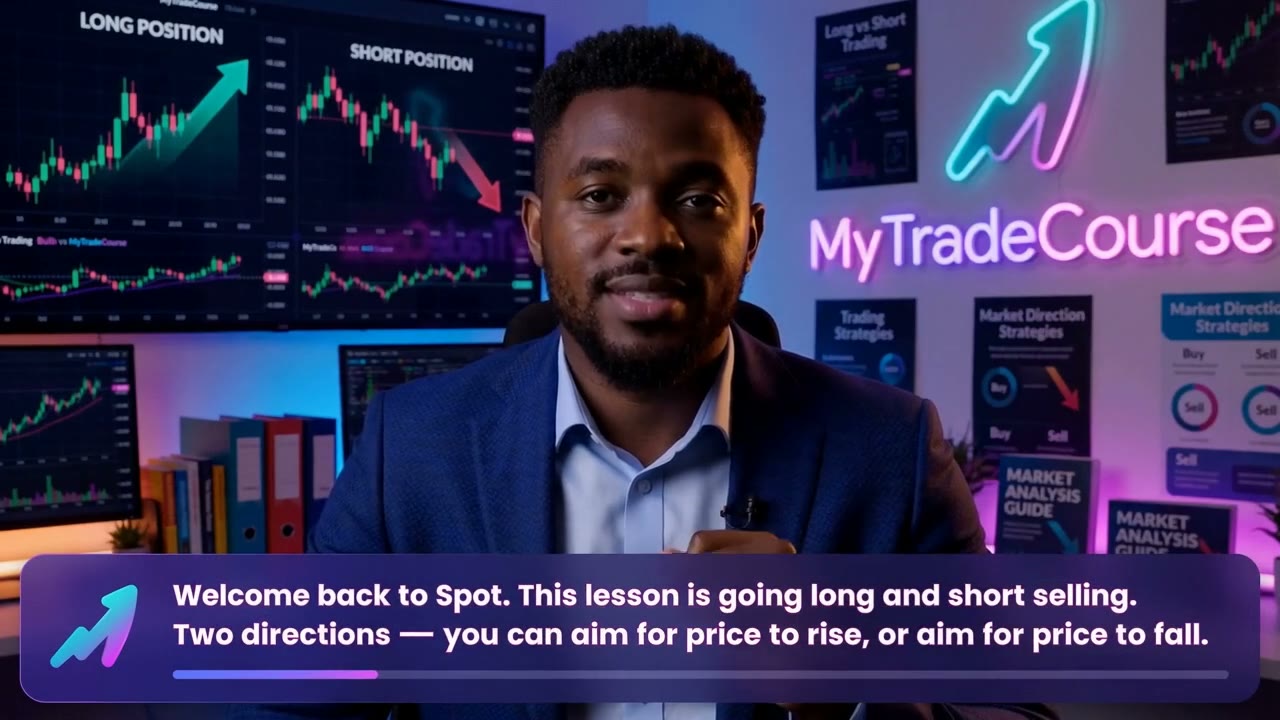
This video is part of Premium
Premium is not open yet. No Premium price is shown and nothing is charged until the owner opens it. The full lesson is below, and the audio is free right now.
Listen — free
The teacher's voice for this lesson (1:00). This lesson's audio is free.
Read the transcript
Welcome back to Spot. This lesson is going long and short selling. Two directions — you can aim for price to rise, or aim for price to fall. Going long is the familiar way. You buy first, hoping the price rises, then you sell later at the higher price. If you bought at ten and sell at twelve, the move up is your gain. Short selling flips it. You sell first, hoping the price falls, then you buy back later at the lower price. Sell at ten, buy back at eight, and the move down is your gain. Short selling usually means borrowing. You borrow the asset, sell it, buy it back later, and return it. Because you must buy it back, a rising price while you are short means growing losses. That is the key risk difference. When you are long, your loss stops at what you paid. When you are short, price can keep rising with no ceiling, so shorts need a plan and a stop before they start. Remember: long means buy first and hope it rises, short means sell first and hope it falls — and short risk can grow fast. Now — try the quick quiz.
Long: the natural direction
Going long is ordinary buying: you own the asset and gain when it rises. Your maximum loss is what you paid — price cannot go below zero. Almost all investing, and all plain spot buying, is long. It is the only direction available in a basic cash account.
Short: sell first, buy back later
Short selling flips the order: you borrow shares, sell them, and hope to buy them back cheaper and return them. In spot markets this needs a margin account and borrowable supply, and you pay interest on the loan. Your broker can also recall the shares or force a buy-back if your collateral runs thin.
The risk is asymmetric
A long trade can lose at most 100%. A short trade's loss is theoretically unlimited, because a price can rise many times over while you owe the shares back at whatever they cost. Crowded shorts can also trigger short squeezes — panicked buy-backs that rocket the price. Shorting is a professional tool; size it small and always with a stop.
Worked example — a short sale
You borrow and sell 100 shares at $40, receiving $4,000. Price falls to $31: you buy back for $3,100, return the shares, and keep $900 minus interest and fees. But if price rises to $55 instead, buying back costs $5,500 — a $1,500 loss, more than a third of the sale proceeds, and it grows with every dollar higher.
Remember this
- Long = buy, own, profit from rises; max loss is your stake.
- Short = borrow, sell, buy back; needs margin and costs interest.
- Short losses are unlimited in theory — always use a stop.
- Squeezes punish crowded short positions violently.
Check what you learned
Completion marks are saved on this device only.
SEO used on this page
| Page title | Set — Going Long and Short Selling — Spot Trading | MyTradeCourse |
|---|---|
| Meta description | Set — Profiting from falls means borrowing — and borrowing changes the risk completely. |
| Share picture | Set — https://mytradecourse.com/media/thumbs/mytradecourse-spot-going-long-lesson-thumbnail.jpg |
| Audio file | Set — /media/audio/mytradecourse-spot-going-long-lesson-audio.mp3 |
| Video file | Set — mytradecourse-spot-going-long-lesson.mp4 (Premium) |
| Captions | Set — /media/captions/mytradecourse-spot-going-long-lesson-captions.vtt |
| Transcript | Set — shown on this page under Listen |
| Structured data | Set — LearningResource + VideoObject |