Records and Taxes: The Boring Edge
Spot Trading Advanced About 5 min Audio free Video · Premium
Every trade creates a tax record whether you keep it or not. Organized traders pay for none of the chaos.
Watch your teacher
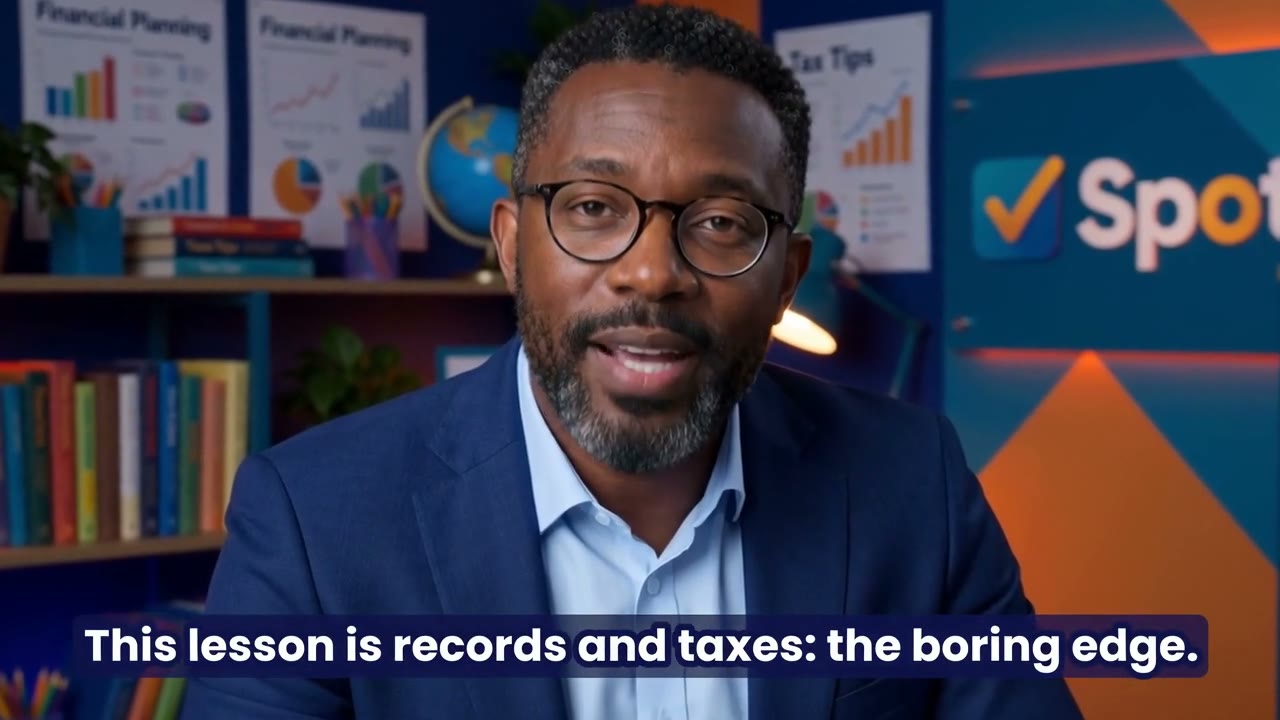
This video is part of Premium
Premium is not open yet. No Premium price is shown and nothing is charged until the owner opens it. The full lesson is below, and the audio is free right now.
Listen — free
The teacher's voice for this lesson (1:00). This lesson's audio is free.
Read the transcript
Welcome back to Spot. This lesson is records and taxes: the boring edge. Keeping clear records is not exciting — but it protects you and makes tax time simple. A good record is simple. For every trade, write the date, what you bought or sold, the price in, the price out, any fees, and one line for why you took it. Taxes are part of trading in most places. Selling for more than you paid can count as a gain, and selling for less can count as a loss. The exact rules depend on where you live and what you traded — this lesson is education only, not tax advice. That is the edge. Clear records mean you can prove what happened, find your own mistakes, and answer questions months later without guessing or digging through old messages. Keep one tidy system. Save your account statements, export your history regularly, and keep your journal in the same place — in MyTradeDiary — so your notes and your numbers always match. Remember: records are your proof, taxes are part of the trade, and tidy notes turn a boring job into an edge. Now — try the quick quiz.
What must be reconstructable
For every trade: date, asset, quantity, entry and exit prices, fees, and the venue. Brokers issue statements and (in many countries) tax forms, but crypto across multiple wallets and exchanges is where records go to die — exports get lost, venues close. Your journal discipline from Foundations doubles as your tax backbone if you log venue and fees alongside the six fields.
Holding period and character matter
Many tax systems tax short-term gains (held a year or less) harder than long-term ones, and treat frequent trading, derivatives, and crypto each by their own rules, which change and differ by country. This lesson is not tax advice — it is a warning that trade frequency and holding period are tax decisions whether you make them deliberately or by accident. One consultation with a local tax professional is cheaper than one restructuring of a year of chaos.
The year-end drill
Monthly: export statements from every venue and save them with your journal backups. Quarterly: reconcile — journal totals vs statements; investigate any mismatch while it's small. Year-end: a folder with every statement, your journal export, and a summary your preparer can actually use. Boring, mechanical, and worth real money.
Worked example — the reconciliation catch
A quarterly check compares the journal to an exchange export and finds 11 trades missing from the journal — all small, all from one impulsive weekend. Beyond the tax record, the catch matters for strategy: those 11 trades netted −2.3R and were invisible to the weekly review. Reconciliation audits your discipline, not just your taxes.
Try it yourself
Export this month's statement from your venue and reconcile it against your journal in MyTradeDiary (free): every statement trade should have a journal entry. Note any gaps and fix the habit that caused them.
Remember this
- Log venue and fees with every trade — the journal doubles as your tax backbone.
- Holding period and trade type change tax treatment; get local professional advice once.
- Export statements monthly; reconcile quarterly while mismatches are small.
- Reconciliation also audits your discipline — missing trades are hidden losses.
Check what you learned
Completion marks are saved on this device only.
SEO used on this page
| Page title | Set — Records and Taxes: The Boring Edge — Spot Trading | MyTradeCourse |
|---|---|
| Meta description | Set — Every trade creates a tax record whether you keep it or not. Organized traders pay for none of the chaos. |
| Share picture | Set — https://mytradecourse.com/media/thumbs/mytradecourse-spot-records-taxes-lesson-thumbnail.jpg |
| Audio file | Set — /media/audio/mytradecourse-spot-records-taxes-lesson-audio.mp3 |
| Video file | Set — mytradecourse-spot-records-taxes-lesson.mp4 (Premium) |
| Captions | Set — /media/captions/mytradecourse-spot-records-taxes-lesson-captions.vtt |
| Transcript | Set — shown on this page under Listen |
| Structured data | Set — LearningResource + VideoObject |