Assignment and Exercise: What Actually Happens
Options Intermediate About 5 min Audio free Video · Premium
Short options can turn into stock overnight. Demystify the mechanics before they surprise you.
Watch your teacher
This video is part of Premium
Premium is not open yet. No Premium price is shown and nothing is charged until the owner opens it. The full lesson is below, and the audio is free right now.
Listen — free
The teacher's voice for this lesson (1:00). This lesson's audio is free.
Read the transcript
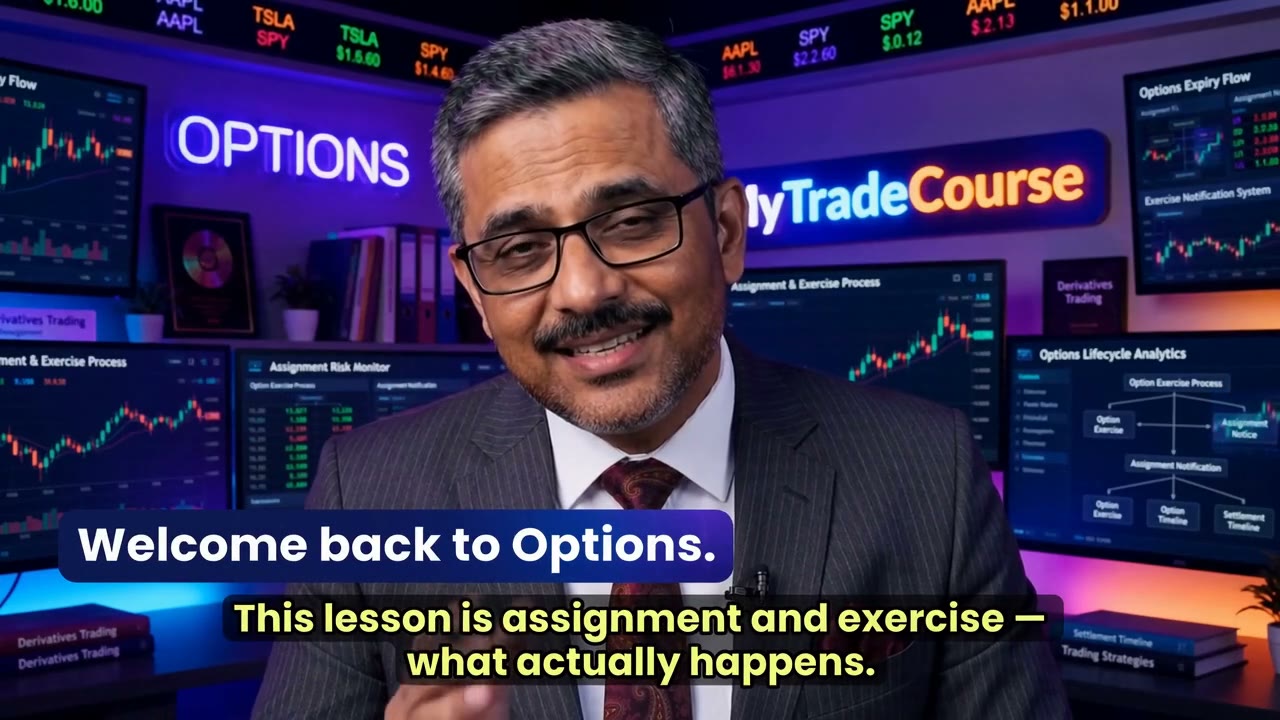
Welcome back to Options. This lesson is assignment and exercise — what actually happens. Exercise is when the buyer uses the right. A call buyer exercises to buy at the strike. A put buyer exercises to sell at the strike. Assignment is the other side. The seller is assigned. That seller must do what the contract promises. For calls that means selling at the strike. For puts that means buying at the strike. It can happen before expiry. Check your account after exercise or assignment. Shares and cash change. Fees can apply. Know the steps before you hold through expiry. Remember — exercise uses the right, assignment makes the seller act. Now — try the quick quiz.
Exercise and assignment, defined
The option buyer holds a right; exercising converts the option into stock at the strike (a call exercise buys 100 shares per contract; a put exercise sells them). Assignment is the other side: a randomly selected seller of that same option is obligated to take the opposite side of the stock trade. American-style options (most equity options) can be exercised any time; European-style (many index options) only at expiry. If you sell options, assignment is not a bug — it is a contractual feature arriving without an appointment.
When assignment actually comes
Rational buyers exercise early mainly to capture a dividend with an in-the-money call (when the remaining time value is less than the dividend), or when a put is deep in the money near expiry. The practical alarms: your short call is in the money and the stock goes ex-dividend tomorrow; any short option in the money at expiry will auto-exercise by rule (the 'exercise by exception' threshold is typically $0.01 in the money). Pin risk — price closing almost exactly at your strike at expiry — leaves your weekend position unknown until the dust settles; professionals close short strikes before that coin flip.
What to do when assigned
Assignment delivers stock (and a cash debit or credit at the strike) plus removes the option. It is a position, not a penalty: you now own (or are short) 100 shares per contract at the strike price, to hold, hedge, or close at market. The genuine risks are capital (the stock needs funding) and surprise (weekend gaps on a position you didn't plan). Defined-risk spreads cap the damage: your long wing remains even if the short leg is assigned.
Worked example — the dividend ambush
A covered-call seller holds 100 shares at $102 with a $100 call sold, trading at $2.30 ($2.00 intrinsic + $0.30 time). Tomorrow the stock goes ex-dividend for $0.85. A rational call holder exercises tonight: paying $100 for stock worth $102 plus the $0.85 dividend beats keeping an option worth $0.30 of time. The seller wakes to sold shares at $100 — assignment. Not theft: arithmetic, visible in advance to anyone who checked the dividend calendar (time value $0.30 < dividend $0.85 = exercise is rational).
Remember this
- Exercise converts an option to stock at the strike; assignment obligates a randomly chosen seller.
- Early exercise is rational mainly around dividends (calls) or deep-in-the-money puts near expiry.
- In-the-money shorts auto-exercise at expiry; near-the-strike 'pin risk' is closed early by professionals.
- Assignment creates a stock position to manage — with defined-risk spreads, your wing still protects you.
Check what you learned
Completion marks are saved on this device only.
SEO used on this page
| Page title | Set — Assignment and Exercise: What Actually Happens — Options | MyTradeCourse |
|---|---|
| Meta description | Set — Short options can turn into stock overnight. Demystify the mechanics before they surprise you. |
| Share picture | Set — https://mytradecourse.com/media/thumbs/mytradecourse-options-assignment-lesson-thumbnail.jpg |
| Audio file | Set — /media/audio/mytradecourse-options-assignment-lesson-audio.mp3 |
| Video file | Set — mytradecourse-options-assignment-lesson.mp4 (Premium) |
| Captions | Set — /media/captions/mytradecourse-options-assignment-lesson-captions.vtt |
| Transcript | Set — shown on this page under Listen |
| Structured data | Set — LearningResource + VideoObject |