Spread Trades: Calendar and Intermarket
Futures Advanced About 5 min Audio free Video · Premium
Trading the difference between two contracts instead of the price of one — futures' built-in relative-value game.
Watch your teacher
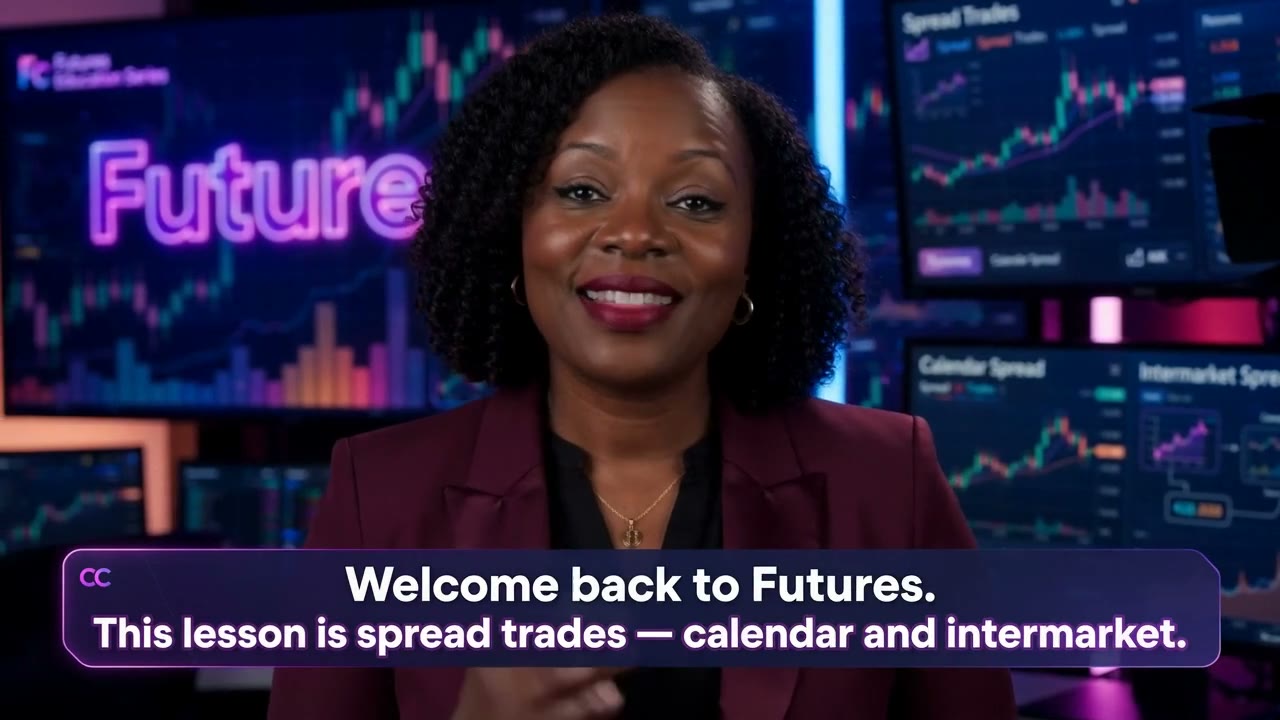
This video is part of Premium
Premium is not open yet. No Premium price is shown and nothing is charged until the owner opens it. The full lesson is below, and the audio is free right now.
Listen — free
The teacher's voice for this lesson (1:00). This lesson's audio is free.
Read the transcript
Welcome back to Futures. This lesson is spread trades — calendar and intermarket. A spread trade holds two linked futures contracts at once. You are long one and short the other, and you watch the price difference between them, not just one price alone. A calendar spread uses the same market in two different months. For example, long the front month and short a later month. The trade is about how the gap between those months changes. An intermarket spread uses two different but linked markets. The two markets often move together, and the spread tracks the difference between their prices instead of one market alone. Both legs matter together. Check the specs, tick values, and liquidity for each contract, plan how you will close both sides, and remember a spread can still lose — the difference can keep moving against you. Remember — spread trades watch the difference between two linked contracts. Now — try the quick quiz.
What a spread trade is
A futures spread is a simultaneous long and short in two related contracts: long December corn / short July corn (a calendar spread), or long crude / short heating oil (an intermarket spread). You profit when the price relationship changes in your favor, even if both legs fall. Because the legs share most risk factors, outright price risk largely cancels — what remains is the relationship risk, which is smaller, slower, and differently behaved.
Why spreads exist and who uses them
Processors live on spreads: a crusher buys soybeans and sells meal and oil (the 'crush'); a refiner buys crude and sells products (the 'crack'). Commercial margin on spreads is often far lower than on outrights because the exchange recognizes the offsetting risk. Speculators use calendar spreads to trade the curve itself (Lesson 9) — storage, scarcity, and roll flows — without betting on the outright price level.
Spread risks are real risks
Lower risk is not no risk: relationships can blow out (a calendar spread that 'never' exceeds 20 cents can print 60 in a squeeze), legs can become illiquid asymmetrically, and brokers may margin intraday spread positions differently in fast markets. Spreads also move slowly — the impatient over-size them to 'make it worthwhile,' converting a low-risk structure into a concentrated one.
Worked example — trading the curve
Crude contango widens: front month $78, next $80 (a $2.00 spread). A trader expecting storage pressure to ease sells the spread — short front, long next — at −$2.00 (quoted as the difference). Two weeks later the spread narrows to −$1.20: the position gains $0.80 × 1,000 barrels = $800 per spread, during a fortnight when outright crude went up, down, and nowhere. The trade was about the relationship, and only the relationship.
Remember this
- A spread is long one contract, short a related one — you trade the relationship, not the level.
- Calendar spreads express views on the curve: storage, scarcity, and roll pressure.
- Spread risk is smaller but not zero — relationships can blow out and legs can go illiquid.
- Slow movement tempts oversizing; resist it — that's how 'safe' spreads blow up.
Check what you learned
Completion marks are saved on this device only.
SEO used on this page
| Page title | Set — Spread Trades: Calendar and Intermarket — Futures | MyTradeCourse |
|---|---|
| Meta description | Set — Trading the difference between two contracts instead of the price of one — futures' built-in relative-value game. |
| Share picture | Set — https://mytradecourse.com/media/thumbs/mytradecourse-futures-spread-trades-lesson-thumbnail.jpg |
| Audio file | Set — /media/audio/mytradecourse-futures-spread-trades-lesson-audio.mp3 |
| Video file | Set — mytradecourse-futures-spread-trades-lesson.mp4 (Premium) |
| Captions | Set — /media/captions/mytradecourse-futures-spread-trades-lesson-captions.vtt |
| Transcript | Set — shown on this page under Listen |
| Structured data | Set — LearningResource + VideoObject |