Backtesting a Forex Idea by Hand
Forex Advanced About 6 min Audio free Video · Premium
Thirty honest hand-tested trades teach more than a thousand curve-fit computer results.
Watch your teacher
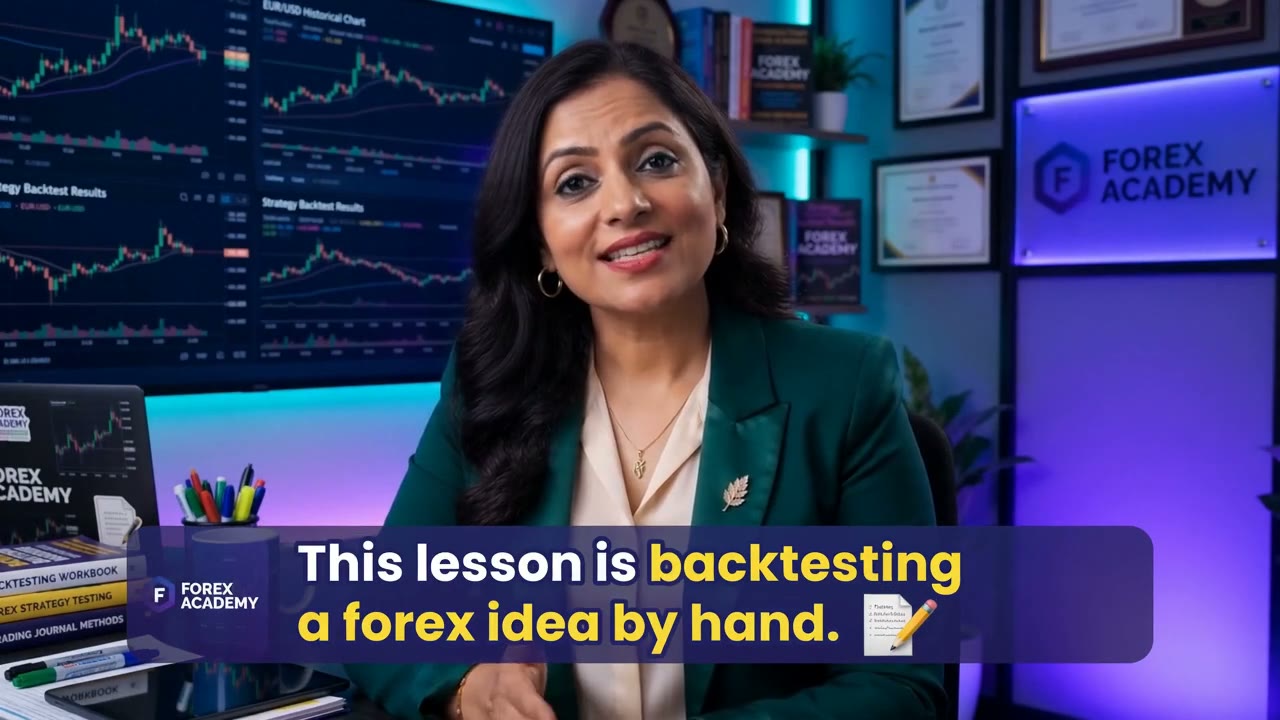
This video is part of Premium
Premium is not open yet. No Premium price is shown and nothing is charged until the owner opens it. The full lesson is below, and the audio is free right now.
Listen — free
The teacher's voice for this lesson (1:00). This lesson's audio is free.
Read the transcript
Welcome back to Forex. This lesson is backtesting a forex idea by hand. Backtesting means testing an idea on past charts. You move back in time. Then you apply your rules candle by candle. Write the idea first. Name the pair and session. Write the entry rule and the exit rule. Do not change them mid test. Record each pretend trade in a sheet. Note the entry and exit. Note the gain or loss in pips. Hide future candles as you go. After many trades, review the totals. Count wins and losses. Check if the idea held up. Small samples prove little. Remember — test the idea on past charts, by hand and honestly. Now — try the quick quiz.
Why by hand, why thirty
Hand backtesting — scrolling a chart bar by bar, applying written rules, logging every trade the rules would have taken — forces you to see every ugly case the computer summary hides. Thirty trades is the minimum where percentages start meaning anything; fifty is better. The rules must be written before you start, every trade logged (no 'I'd have skipped that one'), and the spread of your session subtracted from every result.
The traps that fake a good test
Look-ahead: using information (like the day's close) to decide an entry 'at' that close. Survivorship of attention: your eye finds the beautiful examples and skips the chop — bar-by-bar replay with no skipping is the cure. Parameter shopping: adjusting the stop until history looks great guarantees the parameters fit the past's noise. Test the idea you wrote down, or admit you're designing a new one.
What a passing test looks like
Not 'it made money' — over which sub-periods? A system profitable only in one trending quarter is a regime bet, not an edge. Look for: positive net R after costs, results spread across months and both directions, worst drawdown you could psychologically survive, and consistency with a forward paper test (Foundations, Lesson 2). Then the live step-up (Lesson 19), at minimum size.
Worked example — reading a test honestly
Hand test, 40 trades over 14 months: net +9.5R after spread. By half: first 20 trades +1R, last 20 +8.5R. By regime tag: trend weeks +12R, range weeks −2.5R. Verdict: a real but regime-dependent edge. The plan amendment writes itself: trade it only when the Lesson 10 checklist says 'trend,' and the forward paper test must confirm for a month before live size.
Try it yourself
Pick your simplest forex setup, write its rules in one paragraph, and hand-test the last 30 occurrences on a chart with the spread subtracted. Log every test trade in MyTradeDiary (free) in a separate 'backtest' list with dates and R.
Remember this
- Write rules first; log every trade the rules take — no skipping ugly ones.
- Subtract your session's real spread from every test result.
- Beware look-ahead, attention bias, and parameter shopping — they manufacture fake edges.
- A passing test is positive after costs, across periods and regimes, then confirmed on paper.
Check what you learned
Completion marks are saved on this device only.
SEO used on this page
| Page title | Set — Backtesting a Forex Idea by Hand — Forex | MyTradeCourse |
|---|---|
| Meta description | Set — Thirty honest hand-tested trades teach more than a thousand curve-fit computer results. |
| Share picture | Set — https://mytradecourse.com/media/thumbs/mytradecourse-forex-backtesting-lesson-thumbnail.jpg |
| Audio file | Set — /media/audio/mytradecourse-forex-backtesting-lesson-audio.mp3 |
| Video file | Set — mytradecourse-forex-backtesting-lesson.mp4 (Premium) |
| Captions | Set — /media/captions/mytradecourse-forex-backtesting-lesson-captions.vtt |
| Transcript | Set — shown on this page under Listen |
| Structured data | Set — LearningResource + VideoObject |