The Exchange Safety Checklist
Crypto Advanced About 5 min Audio free Video · Premium
Exchanges are banks that can fail like banks — plus failure modes banks never had. A periodic, written audit.
Watch your teacher
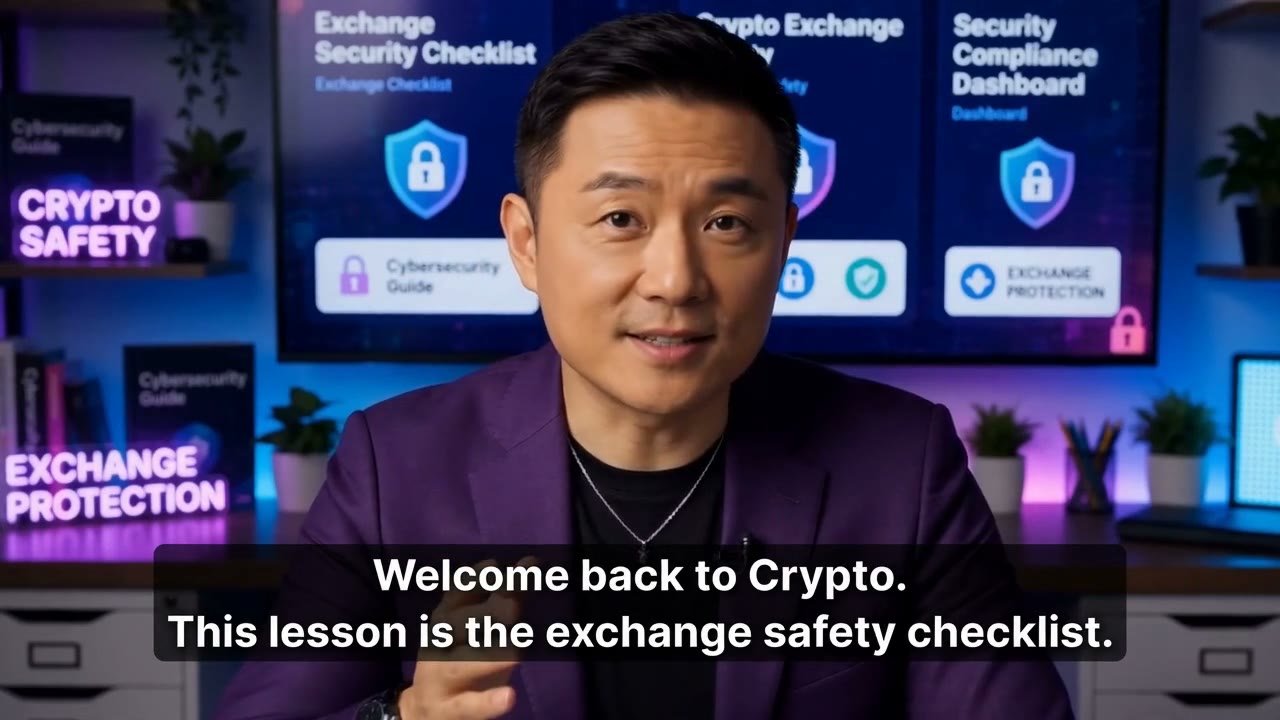
This video is part of Premium
Premium is not open yet. No Premium price is shown and nothing is charged until the owner opens it. The full lesson is below, and the audio is free right now.
Listen — free
The teacher's voice for this lesson (1:00). This lesson's audio is free.
Read the transcript
Welcome back to Crypto. This lesson is the exchange safety checklist. An exchange holds your coins while you trade there. Check safety before you deposit. Start with the basics you can verify. Turn on two factor login protection. Use a strong unique password. Check withdrawal locks and address allow lists if offered. Check how the exchange stores funds. Look for clear proof about cold storage. Look for a clear history and clear status updates. Start small with any new exchange. Deposit a small amount first. Test a withdrawal before you trust it with more. Remember — check the exchange first, protect the login, and test withdrawals small. Now — try the quick quiz.
The quarterly audit (15 minutes)
Run it on a schedule, not on a rumor: (1) Withdrawal test — move a small amount out to your own wallet; success and speed noted. (2) Proof-of-reserves and audit posture — does the venue publish verifiable reserves, and are the attestations from named firms? (3) News scan — lawsuits, regulator actions, executive departures, banking problems. (4) Your exposure total — sum what's on the venue; above your pre-set cap, withdraw the excess to self-custody. (5) Account security — 2FA method, API keys (delete unused ones; withdraw-permissions should almost never exist on an API key), withdrawal address allowlist on.
Reading the warning signs
History's pre-collapse signals rhyme: withdrawal delays blamed on 'maintenance' repeatedly, sudden lucrative deposit promotions, the venue's own token spiking on incentives, executives resigning or feuding publicly, auditors quitting. Any two together justify immediate exposure reduction — being early and wrong costs a wire fee; being late and right costs the balance. In an unregulated patchwork, your own monitoring IS the deposit insurance.
How much belongs on any exchange
The working rule: an exchange holds only what active trading requires — open positions' margin plus near-term orders. Everything else is self-custody (Lesson 1) or, for stablecoin treasury, spread with the Lesson 7 discipline. Set the cap as a number in advance ('never more than $X or Y% of the portfolio on one venue'), because in a boom the balance grows into danger without any decision ever being made.
Worked example — the audit that paid
Quarterly audit, a mid-size exchange: the small test withdrawal takes 26 hours instead of the usual 1 (noted). News scan finds its auditor has resigned and a regulator in a major market has opened an inquiry. Two warning signs → the checklist's rule fires: excess funds out that week, trading balance cut to the minimum. Six weeks later the venue halts withdrawals entirely. The audit's total cost was an hour and a few network fees; the rule existed in writing before it was needed, which is the entire point.
Try it yourself
Run the full checklist on your main venue now and record it in MyTradeDiary (free): withdrawal-test time, reserves posture, your total exposure versus your written cap, API keys pruned, allowlist status. Set a calendar reminder for the next quarterly run.
Remember this
- Audit quarterly in writing: test withdrawal, reserves, news, exposure vs cap, account security.
- Two warning signs (delays, auditor exits, regulator actions, desperation promos) = reduce exposure first, investigate second.
- Exchanges hold working capital only; the cap is a number written in advance.
- In crypto, your monitoring is the deposit insurance.
Check what you learned
Completion marks are saved on this device only.
SEO used on this page
| Page title | Set — The Exchange Safety Checklist — Crypto | MyTradeCourse |
|---|---|
| Meta description | Set — Exchanges are banks that can fail like banks — plus failure modes banks never had. A periodic, written audit. |
| Share picture | Set — https://mytradecourse.com/media/thumbs/mytradecourse-crypto-exchange-safety-lesson-thumbnail.jpg |
| Audio file | Set — /media/audio/mytradecourse-crypto-exchange-safety-lesson-audio.mp3 |
| Video file | Set — mytradecourse-crypto-exchange-safety-lesson.mp4 (Premium) |
| Captions | Set — /media/captions/mytradecourse-crypto-exchange-safety-lesson-captions.vtt |
| Transcript | Set — shown on this page under Listen |
| Structured data | Set — LearningResource + VideoObject |